In a civilized society, people shouldn’t have to steal or grovel in order to have enough to eat. The social compact between the governed and their government should take care of that. But when that compact is strained ... others must step up.
In the 1930's, a rather unusual court case came to pass in New York City ...
A woman was being charged with stealing a loaf of bread. She seemed to have a good case. She was poor and taking care of her daughter and two grandchildren after their father had abandoned them.
Unfortunately, the shop-keeper refused to drop charges. He felt that, because it was a bad neighborhood, if one person stole and got away with it, then it would encourage more to do so. He feared for his safety and his business, and he wanted to teach all the other people in the neighborhood a lesson. And he certainly did do that, though not in the way he had envisioned.
You see, the Mayor of New York, Fiorello LaGuardia, was known for occasionally stepping in as a magistrate of the court. He would preside over certain cases of special interest. He was well-loved by many and known for being a firm yet fair mayor.
In this instance, Mayor LaGuardia stepped to the front of the courtroom, placed his famous hat down, and prepared his ruling: "The shop-keeper is correct that you have broken the law and that you must be punished. You will spend 10 days in jail or pay a fine of $10."
Back then, $10 was a hefty sum of money. The woman knew she was going to jail, and the shop-keeper was quite happy with this outcome. But nobody could have imagined what happened next.
Something interesting was brewing inside Mayor LaGuardia's head and heart. And as he spoke the woman's sentence out loud, he slowly pulled from his pocket a $10 bill. He placed it into his famous hat and stated that her fine was now paid.
The look of shock on the shop-keeper’s face was priceless! How could the mayor betray his people like that, the businesses who paid the taxes of the city and helped keep it running? Meanwhile a poor, law-breaking, thieving woman was being let off scot-free without any punishment whatsoever? Nobody understood that, until Mayor LaGuardia issued his second sentence for the afternoon.
"In addition to the $10 fine this woman has now paid, I fine everybody else in this courtroom fifty cents.” The room gasped in shock as he continued ... "For living in a town where a grandmother must steal bread just so that her daughter and grandchildren would not starve to death. Bailiff, please collect the fines right now ... And give them to the defendant." (G. Van Ekeren, Words for All Occasions. (Prentice Hall: 1988))
Why did LaGuardia pay the fine and order everyone in the courtroom to ante up? In a civilized society, people shouldn’t have to steal in order to have enough to eat. The social compact between the governed and their government should take care of that. But when that compact is strained, as it is now and as it was in depression-era New York, others must step up.
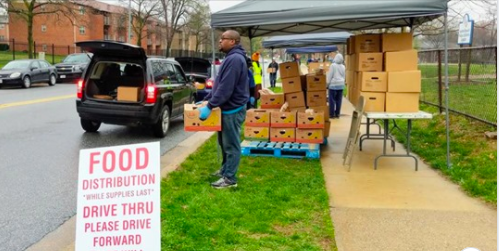
We have an unprecedented challenge of food insecurity in Baltimore County right now, one that demands an unprecedented response . It’s why I’ve asked the NeighborSpace Board to stand with the boards of a growing number of nonprofits, community associations, and other groups to “ ADAPT ”on a special, worldwide day of giving, #GivingTuesdayNow (May 5), i.e., to A sk our D onors to A id P andemic-relief T oday. In other words, we plan to ask you for money to support organizations on the front-lines of feeding the hungry in Baltimore County rather than asking for your support of our mission. Let me explain why.
1. Suburban Poverty Has Been Outpacing Urban Poverty for Years
One expert notes that:
The suburbanization of poverty is one of the most important demographic trends of the last 50 years . Poverty rates across the suburban landscape have increased by 50 percent since 1990. The number of suburban residents living in high poverty areas has almost tripled in that time.
Allard, S. The Conversation. “Why poverty is rising faster in suburbs than in cities.” (2018). (Available at: https://theconversation.com/why-poverty-is-rising-faster-in-suburbs-than-in-cities-97155)
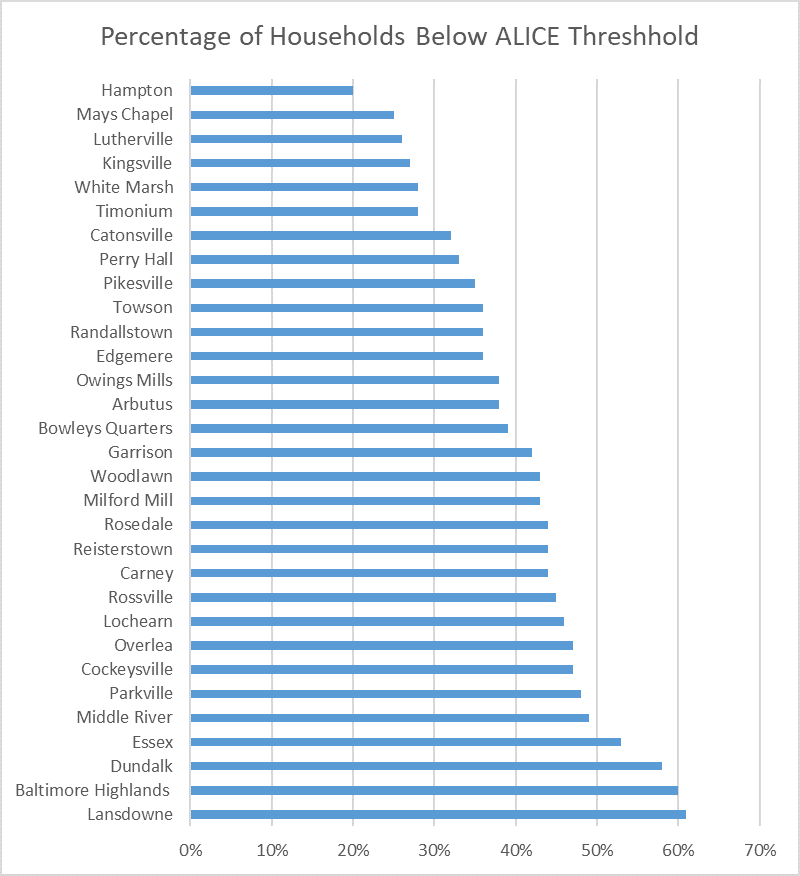
How bad is it in Baltimore County? A 2017 report by the United Way of Central Maryland found that Baltimore County had almost 91,000 households who were Asset-Limited, Income-Constrained, and Employed (ALICE). These households made too much money to qualify for public benefits, but not enough to pay for housing, utilities, transportation, healthcare, education, and food, a threshold that the ALICE Report put at $61,224 for a family of four in Baltimore County in 2017. When added to the households that qualify for benefits, the number in need approaches 119,000 people. The chart below shows how these households are distributed across the County:
Source: United Way of Central Maryland, Alice in Baltimore County (2017). (Available at: https://www.uwcm.org/alice/)
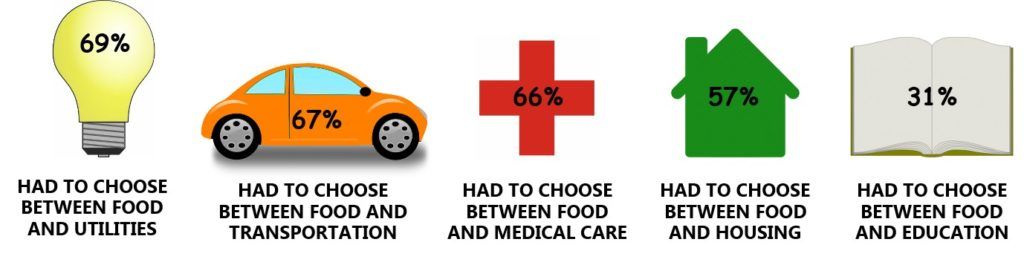
2. As Poverty Has Grown, Food Has Taken a Back Seat to Other Needs
Source: FeedingAmerica.org
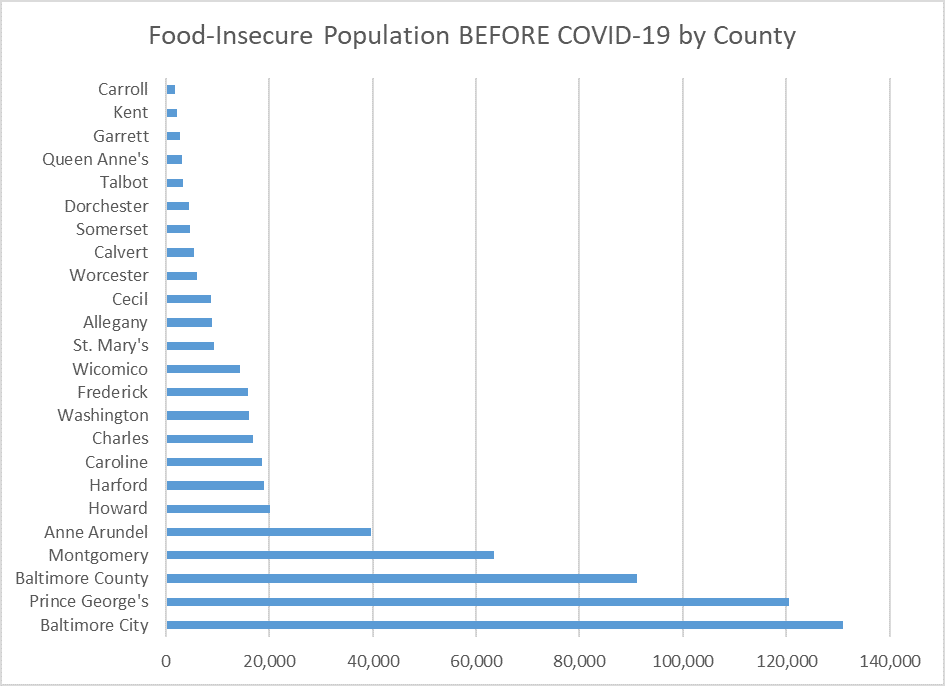
The result is that 11 percent of the County’s population was food insecure BEFORE the PANDEMIC , meaning that they had limited or uncertain access to or ability to acquire nutritionally adequate and safe foods in socially acceptable ways. (U.S. Dept. of Agriculture). Compared to other Maryland jurisdictions, Baltimore County had the 3 rd highest number of food insecure residents, as shown in the chart below:
Source: County Health Rankings & Roadmaps; https://www.countyhealthrankings.org/app/maryland/2020/measure/ factors/139/data
3. The Onset of the Pandemic Has Made a Bad Situation Worse in Baltimore County
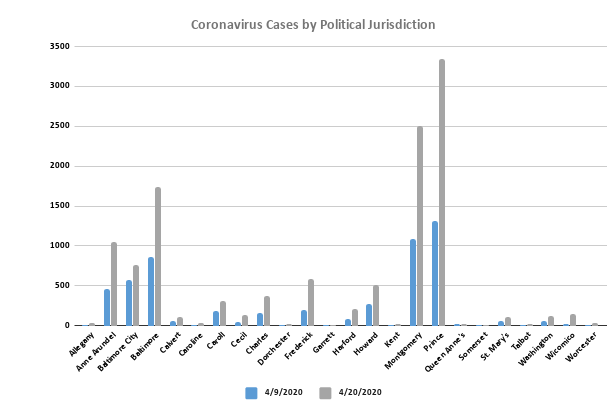
As shown in the chart below, Baltimore County has the 3 rd highest number of Coronavirus cases in the State and the number of new cases continues to rise:
Source:https://www.google.com/search? q=coronavirus+cases+by+county%2C+Maryland&oq=coronavirus+cases +by+ county%2C+Maryland&aqs=chrome..69i57j35i39.9548j0j7&sourceid=chrome&ie=UTF-8
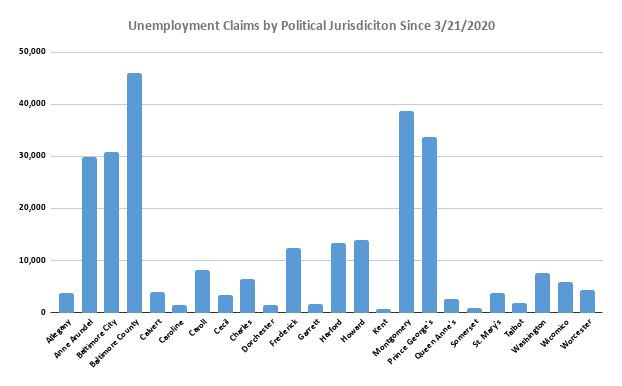
Over 46,090 County residents have filed for unemployment benefits, the highest number of claims in the State :
Source: https://www.dllr.state.md.us/employment/uicounty.shtml
With more people out of work and schools closed, a bad problem has snowballed . One leader of a County organization on the front-lines reported this just last week:
Our small organization … has been collecting and distributing food at two distribution sites one day a week since schools closed three weeks ago in Baltimore County. Despite marked increases in donations … we are still regularly running out of food in about an hour as the need is growing exponentially each week. We are getting e-mails from parents who have lost jobs and are running out of food for their children. (Laurie Taylor-Mitchell, President, Student Support Network).
In short, the increasing numbers of food-insecure people are straining the ability of our government and organizations like the Student Support Network to help them . More must be done, which led to Let’s ADAPT, an effort by county organizations who aren’t on the front lines of the COVID-19 response to help those who are .
4. What You Can Do to Help Now
You’ll be hearing more about the project in the coming days, but there are three things you can do to help right now:
- If you are a member of an organization that is not on the front-lines, but would like to help, join us . You can do so by filling out a short form on the Let’sAdapt.org website. Once you do, we’ll add your group to the growing list of participating organizations. We’ll also send you the messaging and graphics to use to reach out to your supporters by email and/or social media between April 28 and May 5, which is the length of the Let’sAdapt Campaign for Food Insecurity in Baltimore County.
- If you know of an organization that you think should join or you want to make friends and family aware of the effort, please share this fact sheet .
- If you know of an organization on the front-lines where you live , send us an email at letsadaptbaltimorecounty@gmail.com , so that we can add them to the list of organizations that will appear on the donation page of our website.
Thank you for the privilege of your time and attention and for helping us to ADAPT on #GivingTuesdayNow, May 5, 2020.