
I’ve done many things in my life, but none have made me feel more a part of a community than my work with NeighborSpace. By that, I mean, that getting to know and work side-by-side on common goals with so many of you - our supporters and partners in government, community associations, and other nonprofits – has been a deeply meaningful part of my life and a true privilege and honor.
Within our community, I know there are many among us for whom the current coronavirus pandemic is more than a little trying, on many different levels. And so, today, I write to you, not so much as the Executive Director of NeighborSpace, but as a fellow community member to share some small thoughts with friends for coping and getting through this. Most of these ideas are drawn from a blog I write directed at helping small nonprofits and the people that run them thrive and grow. My advice, which I expand upon below, is this: (1) “Do without Doing”; (2) Embrace the Tech that Lets You Work from Home; (3) Read (or Listen to) More Books; (4) Curate Knowledge to Deepen Understanding; and (5) Beware the “Butterfly Effect.” Here we go.
1. Do Without Doing
Spending as much time as we are currently away from other people presents a rare opportunity to slow down, to be alone with our thoughts, and to reflect on who we are and how we perceive and interact with others and the outside world. If you want a quick read that will help you do that, let me recommend Benjamin Hoff’s, The Tao of Pooh .
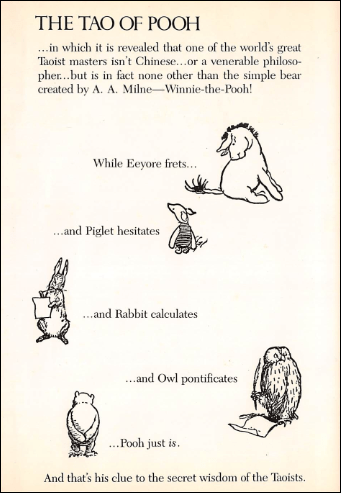
In it, Hoff chastises us for living at a continually frenetic pace:
[D]own through the centuries, man has developed a mind that separates him from the world of reality, the world of natural laws. This mind tries too hard, wears itself out, and ends up weak and sloppy. Such a mind, even if of high intelligence, is inefficient. It goes here and there, backwards and forwards, and fails to concentrate on what it's doing at the moment. It drives down the street in a fast-moving car and thinks it's at the store, going over a grocery list. Then it wonders why accidents occur. (B.Hoff, The Tao of Pooh, pp. 77-78).
The result is that we fail to appreciate the true nature of ourselves, other people, and the world in which we live.
Through the adventures of Winnie the Pooh and pals, Owl, Rabbit, Eeyore, Piglet, Tigger and Christopher Robin, we learn how to stop being such “bisy backsons.” We have to stop long enough to hear through our own ears and see through our own eyes: “[w]hile the clear mind listens to a bird singing, the Stuffed-Full-of-Knowledge-and-Cleverness mind wonders what kind of bird is singing.” (Hoff, p. 146). While Rabbit, Owl and Eeyore are trying to have an intellectual conversation about ornithology, Pooh is enjoying the cacophony of the song and ends up the true hero of Winnie-the-Pooh and The House at Pooh Corner, as a result.
We also have to understand who we are and our limitations. Hoff illustrates this through a Pooh song:
Cottleston, Cottleston, Cottleston Pie,
A fish can’t whistle and neither can I.
Ask me a riddle and I reply:
“Cottleston, Cottleston, Cottleston Pie.”
In Hoff’s view, “A fish can’t whistle and neither can I,” stands for the importance of understanding one’s limitations:
There’s nothing wrong with not being able to whistle, especially if you’re a fish. But there can be lots of things wrong with blindly trying to do what you aren’t designed for. Fish don’t live in trees, and birds don’t spend too much time underwater if they can help it. Unfortunately, some people – who always seem to think they’re smarter than fish and birds, somehow – aren’t so wise, and end up causing big trouble for themselves and others …. That doesn’t mean that we need to stop changing and improving. It just means that we need to recognize what’s there. (Hoff, p. 43).
Finally, we have to stop working against the laws of nature and start working them, resisting egotistical desire to fit square pegs into round holes. Hoff illustrates this point with a story involving Pooh, Piglet, and Tigger.
Piglet has two jars of pickles that he can’t open and asks Pooh for help. Pooh easily opens the first jar and when asked how he did it, responds as follows: “It’s easy,” said Pooh. “You just twist on it like this until you can’t twist any harder. Then you take a deep breath and, as you let it out, twist . That’s all.” (Hoff, p. 76).
Jealously watching the stunt is Tigger, who is now determined to open the second jar:
“Let me try that!” yelled Tigger, bouncing into the kitchen. “Where’s that new jar of pickles? Ah, here it is.”
“Tigger,” began Piglet nervously, “I don’t think you’d better ---“
“Nothing to it,” said Tigger. “Just twist, and ---"
CRASH! …
“Slipped out of my paw," explained Tigger.
“He tried too hard,” said Pooh. (Hoff, p. 76).
The bottom line is that when we learn to work with our own inner nature, and with the natural laws operating around us, we reach the level of Wu Wei, which, translated, means “do without doing.” Then we act in accordance with the natural order of things and operate on the principle of minimal effort.” (Hoff, pp. 68-69). Learn much more by reading the full article: Do Without Doing: Life Lessons on Happiness & Productivity from an Unlikely Source .
2. Embrace the Tech that Lets You Work from Home
In their 2013 book, Remote: Office Not Required , authors Fried and Hansson note that:
[O]ffices have become interruption factories. A busy office is like a food processor – it chops your day into tiny bits. Fifteen minutes here, ten minutes there, twenty here, five there. Each segment is filled with a conference call, a meeting, another meeting, or some other institutionalized unnecessary interruption. (Fried and Hansson, p. 13).
Forty percent of the nonprofit workforce in the U.S. operates remotely, i.e., without a formal business office. The NeighborSpace staff are among them. I used to feel a little stigmatized by that, until I read Fried and Hansson’s book.

Remote work means less overhead, less stress, and pollution reduction, all of which are really important to a small nonprofit. I’m guessing many of these things are important to you, too. So how do you manage it?
Technology is the driver. To improve remote teamwork, it is important to set up multiple methods of communication. They include scheduled phone conferences, email, instant messaging systems, community forums, social media channels, and chat programs. One source underscores the importance of using technology to create a virtual watercooler, noting that:
The office watercooler is one of the last secular places for people to connect with one another, but moving to a virtual environment doesn’t necessarily mean giving it up. Solutions like Slack or Zoom can make it easy for people to instantly message their peers as easily as they could pop over to the next cubical. But as I wrote earlier, technology is not enough. Your virtual culture should give people a place to connect informally, ask questions and -- perhaps most importantly -- be vulnerable. In my experience, vulnerability in the workplace is one of the best foundations for creating trust, a sense of community and purpose. (Frankfurt, T. How to Take Your Nonprofit or For-Profit Workforce Virtual. Forbes Technology Council (1/25/2019) )
Within NeighborSpace, we use a variety of cloud-based software to facilitate our team’s daily work. The products fall into the following broad categories:
- Core apps for things like note-taking and web-clipping (e.g., Evernote ), project and task management (e.g., Nozbe), and office productivity suites (e.g., GSuite )
- Screen sharing and video conferencing apps (e.g., Hangouts Meet ; GoToMeeting )
- Cloud storage and backup applications (e.g., Cloud HQ )
- Miscellaneous applications and services like Tech Soup , Nitro PDF , and Snagit .
One important factor for us in choosing applications is ensuring that they work together and across platforms, giving us great flexibility in where and how we work together. You can read more about exactly what we’ve chosen and why in the full article: The Remote Nonprofit: Meeting Your Mission Virtually.
3. Read (or Listen to) More Books
Grow personally. Hone your skills. In just 15 minutes .
Are you enticed? I just illustrated a strategy advocated by the late Steve Jobs as the right way to introduce a product to an audience. Jobs lived by “the rule of three.” He believed that an audience won’t remember more than three things, so you should cast your key message in terms of three ways that your product ( aka service, proposal, idea, etc.) will help your audience solve its problem. By way of illustration, in launching the iPhone, Jobs repeatedly said it combines three devices: a touchscreen iPod, a phone, and an Internet communicator.
I gained this insight from a book by Carmine Gallo entitled, The Presentation Secrets of Steve Jobs . But I have to confess that I didn’t read the whole book. I listened to “the blinks” from the book on one of my daily walks around Parkville.
What’s a “blink?” It’s a key point contained in a summary of a nonfiction book. The summary can be read or listened to in 15 to 20 minutes. The service and related app that compiles the blinks is known as “ Blinkist.” Once you subscribe, you have access to a growing list of over 2,000 nonfiction book summaries accessible as text or audio files.
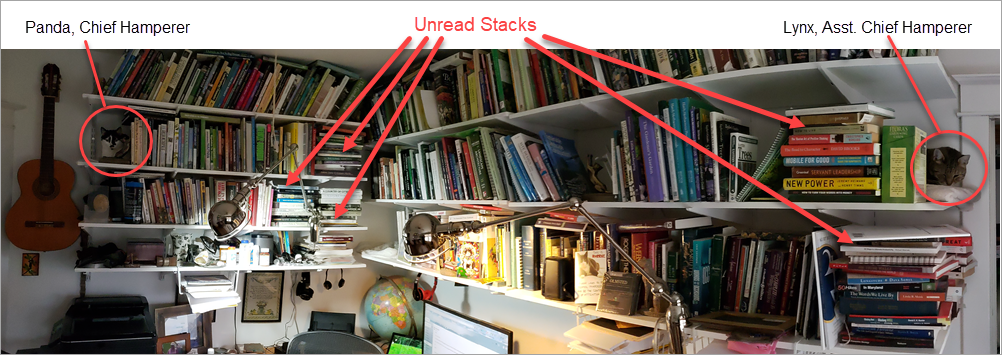
Some will opine that this is heresy, a great affront to the pleasure and value of reading for its own sake. I acknowledge that sentiment, and, if I had more time and owned many fewer unfinished books, I would agree with you. (See photo of my office bookshelves, below, where the unread stacks, and my shelf-climbing cats, Panda and Lynx, act as bookends for the other books). I won’t stop buying books or reading them cover to cover when I can. (I typically pick up hard copies of the books I’ve enjoyed on Blinkist). I have stopped feeling badly as I read the Sunday book review, however, about not having at my disposal some of the great insights from recognized thought leaders. In the words of Mark Twain, “The man who does not read good books has no advantage over the man who cannot read them.” For more about Blinkist, including topics covered and cost, read the full article: Grow Personally. Hone Your Skills. All in Just 15 Minutes.
4. Curate Knowledge to Deepen Understanding
American author and philosopher, Criss Jami, has aptly described the challenges we all face every day in our personal lives and organizations in dealing with information overload:
In the age of technology there is constant access to vast amounts of information. The basket overflows; people get overwhelmed; the eye of the storm is not so much what goes on in the world, it is the confusion of how to think, feel, digest, and react to what goes on. ( Jami, C. Venus in Arms. (Create Space Independent Publishing Platform: 2012))
One strategy is to separate the wheat from the chaff by “commonplacing” what’s important to you, which involves:
- Selecting “knowledge” that you determine worthy of saving for later as a source of inspiration or wisdom. (The selected knowledge often takes the form of quotes, anecdotes, observations, letters, poems, proverbs, drawings, photographs, prayers and the like).
- Transferring the information to books, notebooks, card catalogs, or, in more modern settings, on one's own website or in a notetaking application like Evernote.
- Organizing the information in some way, often under topical or thematic headings, so that it can be retrieved, reviewed, and used at a later time.
I first learned of the practice on a visit to Thomas Jefferson’s home, Monticello, where his commonplace books, filled with notes and drawings about the law, gardening, architecture, etc., were on display. The practice, which has its origins in the 13th century, has seen a modern resurgence:
It may seem an esoteric practice, but commonplace has re-emerged among digital explorers as a modern solution to information overload. Like letterpress, typewriters, and writing by hand, a new creative class of authors and knowledge workers is employing commonplace as a way to find deeper connections to their work and life. (Evernote Blog)
It turns out that Ronald Reagan was a prolific commonplacer who greatly feared being without the large volume of meticulously organized index cards containing his notes. Bill Gates commonplaces through a blog called Gatesnotes . Anyone can subscribe and the range of topics discussed is fascinating.