A failure to plan is a plan to fail.
~ Winston Churchill
A year ago, I wrote
an article
in this publication recounting the findings of the 2019
Spending Affordability Report
authored by a committee of the same name and chaired by first-district councilman, Tom Quirk. The report detailed a history in our County of underinvestment in schools, infrastructure, and retiree healthcare benefits, along with the existence of long-term financial commitments that were described as “unaffordable.” Referring to an earlier book, which described the County government as being in a similar pickle back in 2000, I said that we were “at a crossroads again.”
Fortunately, the new administration was quick to take action. And among those actions was creating a strategic plan. If you haven’t seen it, you can download your own copy on the County’s website .
Now I know strategic planning is, to many, a BIG yawn. Okay, I understand that. But I’ve been doing it for my entire professional life and writing about it extensively on my blog . I think it has made a big difference for the organizations with whom I’ve worked, including NeighborSpace. And I agree with Winston Churchill that an organization that fails to plan is going nowhere on a fast train.
If you’ll stick with me a moment more, I want to give you a flavor of what’s in the County’s plan and how I think it will move us beyond the crossroads, highlighting (A) the process by which it was developed, (B) its contents, (C) what I think it means for the work of NeighborSpace, and (D) some thoughts about what will need to happen for it to be successful.
A. Process
Without counsel plans fail, but with many advisers they succeed.
~ Solomon
Thankfully, this is not a plan that was developed in a back room by a bunch of old, white men in suspenders, smoking cigars and sharing platitudes about how government should work. Rather, as the diagram below makes clear, it is the product of stakeholder roundtables, the work of the transition team, citizen feedback obtained online and at Town Hall meetings, the work of the Commission on Fiscal Sustainability, and internal agency input.
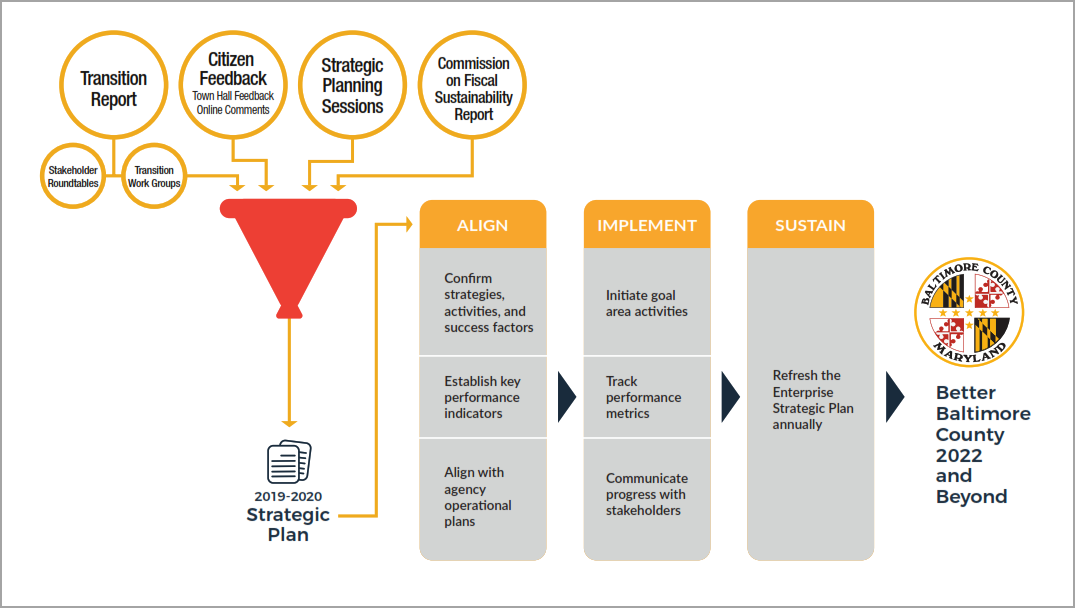
NeighborSpace had two board members who served on the Transition Team and I participated in a Stakeholder Roundtable. It is certainly true that the plan is not a mirror of every idea that we submitted via those channels. But it is clear that a variety of ideas from a broad cross-section of stakeholders did find their way into the plan and I think this bodes well for its success.
B. The Plan’s Contents
To give you a flavor for the contents, I’m going to do the following: (1) Highlight word usage, because I think it reflects what we would hope to see in a plan for a government facing many long-standing challenges and needing to be more accountable to the residents it serves; (2) Share some of the rather startling demographics undergirding the plan; and (3) Provide a brief overview of the plan elements.
1. Word Usage
" The difference between the almost right word and the right word is really a large matter. 'tis the difference between the lightning bug and the lightning.” ~ Mark Twain
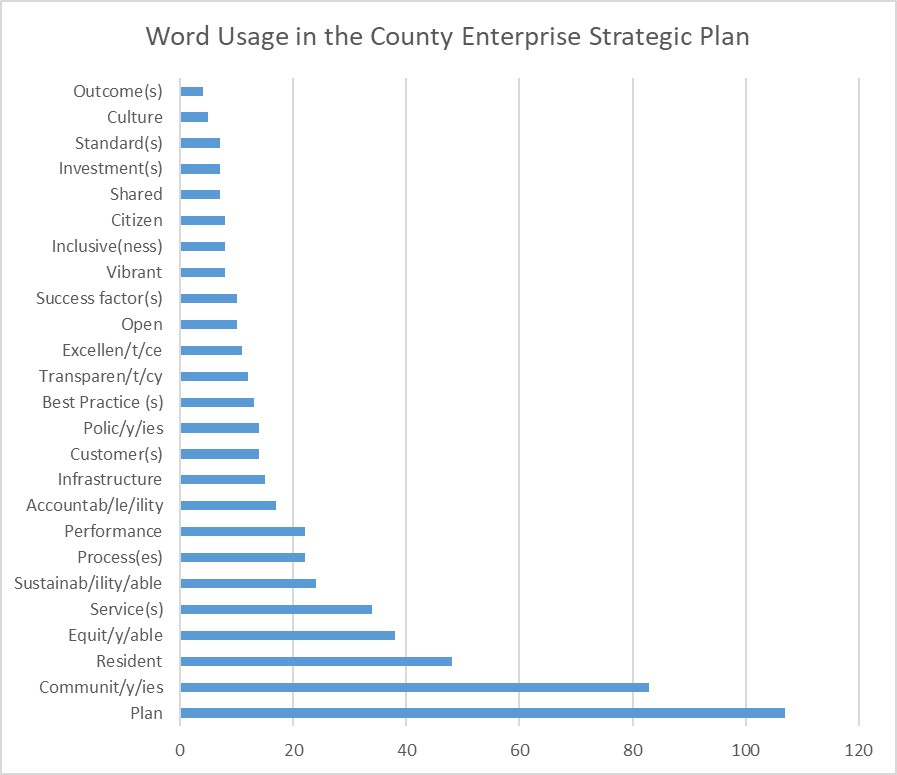
Words matter, especially when they’re driving a budget. Without propping our feet up and settling in for a cover-to-cover read of the plan, we can tell a whole lot about its contents with a few clicks of a keyboard using software that looks at concentrations of important words. In a plan for a government, we would hope to see a focus on the communities and residents it serves. Knowing what we know about the challenges that have existed in our government, we would hope to see mention of standards , policies, and processes that will ensure that services are provided equitably and sustainably , that there is focus on modernizing infrastructure , and that improvements are guided by best practices . Performance management goes hand-in-hand with plan implementation and is a way of holding public servants accountable to county residents for implementation. That is why establishing expected outcomes associated with the goal activities is also vitally important. Finally, we would hope that plan development, implementation and evaluation are inclusive , open and transparent to all, both inside and outside of the organization.
Dropping the results of my quick word-usage survey into a spreadsheet yielded the following chart. I’m sure you will agree that, in the 34 pages that comprise the report, it is heartening to see the frequency with which words like performance , process, sustainability, service, equity, residents, and communities are used. The context in which they are used also does not disappoint, as we shall see below.
2. Demographics
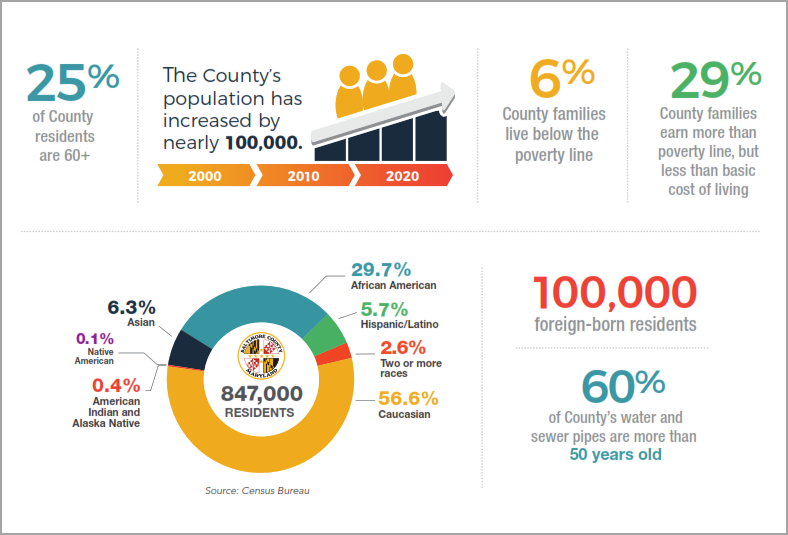
Like every good strategic plan, the County’s plan provides a “scan” of the environment, i.e., a snapshot of the circumstances that are driving the plan’s goals and strategies. Some of the statistics are startling. Population has grown to 847,000, a leap of 100,000 residents since the year 2000. We have the 4th highest per capita income in Maryland; and, yet, 35 percent of families earn less than the County’s basic cost of living. Among counties on the east coast, Baltimore County is second in the proportion of residents 60+, a statistic, which, today, stands at 25 percent. Finally, 60 percent of the water and sewer infrastructure is more than 50 years old – this is really NOT good news given that the design lifespan of such infrastructure is 50 years .
3. Plan Elements
a. Mission, Vision & Values
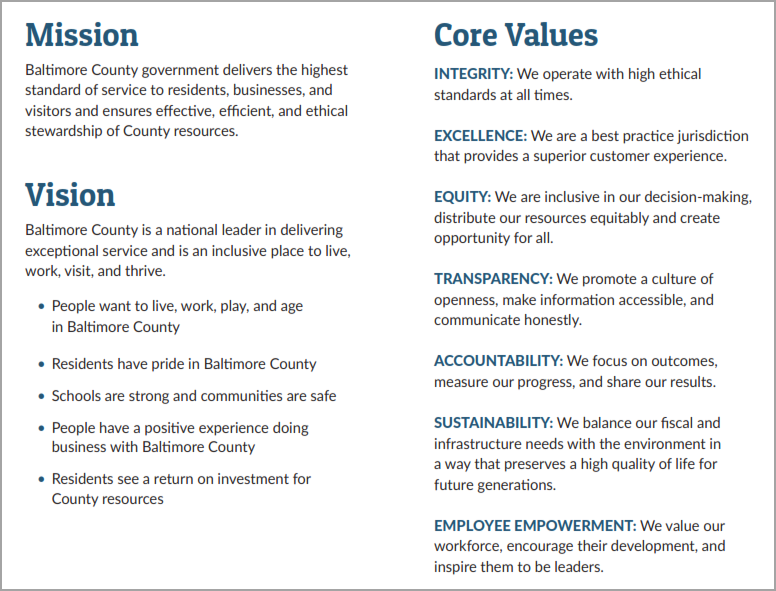
Plan elements align with accepted tenets for strategic planning. The mission statement, shown in the snapshot below, is a clear and concise description of what the government does, focusing on quality services and appropriate management of resources. The vision statement describes the state of affairs that will exist if the mission is met: people want to live and work here, the experience of dealing with the government is a positive one, and residents reap benefits from appropriate stewardship of County resources. The core values, moreover, set expectations for how the work will be carried out and contain many of the important words, e.g., equity, transparency, accountability, sustainability, that were in the word survey reviewed above.
b. Goals
The meat of any plan is in its goals, strategies and activities. These are the things that drive budgets, agency work plans, and individual performance reviews.The County’s strategic plan sets six overarching goals, which are shown in the diagram below. They should address the challenges and opportunities collected through the various input channels outlined above. The next step for us is to ask whether, in fact, they do.
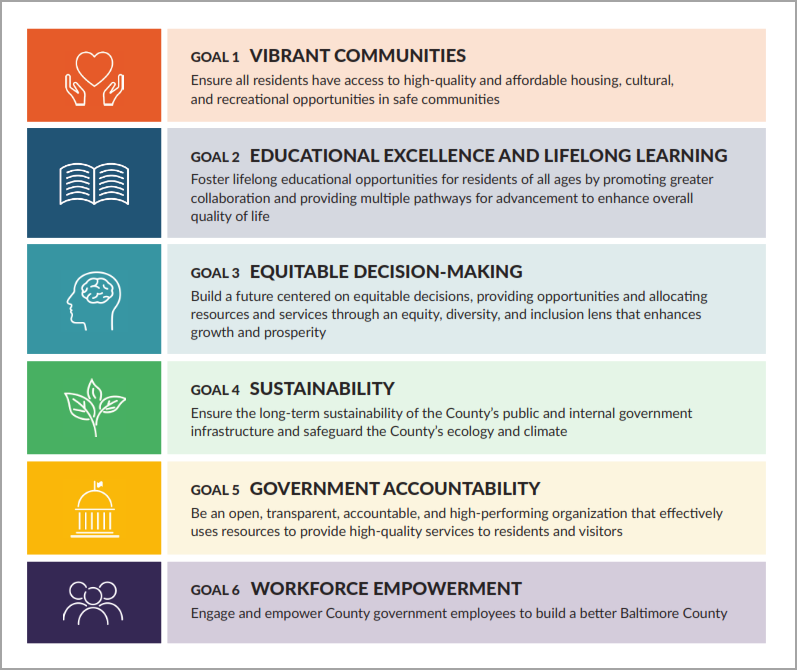
While many people probably wish more of their “pet issues” were included, I think you have to conclude that this plan strikes at the heart of a lot of pressing issues. When it comes to vibrant communities ( GOAL 1
), it is no secret that much of the housing infrastructure in the County is old, that affordable housing is now and has always been a pressing challenge, and that we have fallen short in providing sufficient open space for recreation.One only has to pick up the paper now to be reminded of challenges in education ( GOAL 2
) related both to curriculum, student success rates, and infrastructure. In the past, the paper has also been a reliable source of information on inequitable decisions by County government as wells as accounts of situations where County entities punted, making no decision at all on important policy questions. So, a focus on equitable decision-making ( GOAL 3
) is quite refreshing and it goes hand-in-hand with a government that is truly accountable ( GOAL 5
) to its citizenry.
With our many miles of coastline, acres of impervious surface, and plethora of challenged tributaries feeding into the Chesapeake Bay, sustainability ( GOAL 4 ) challenges abound. It is also true that there are many smart, talented people in our government who really need to be empowered ( GOAL 6 ) to apply themselves to these and the foregoing problems and to collaborate with communities and nonprofits like NeighborSpace on viable solutions. For the first strategic plan that I have seen from County government in my ten years with NeighborSpace, I think this one does a very good job of sizing up the most pressing and pernicious challenges and laying out goals and strategies for addressing them.
C. Implications for the Work of NeighborSpace
There are several places where the plan dovetails with the mission and strategic thinking of NeighborSpace. Here are the strategies where we hope to engage with and be a supportive partner of the County:
- Goal 1: Vibrant Communities
- Strategy 2: Provide sufficient public facilities, programs and opportunities to protect and enhance both physical and behavioral health
- Identify and pursue additional key properties for park acquisition, including pocket parks within downtown and “main street” locales
- Facilitate capacity building of nonprofits and community associations
- Increase and improve access to open spaces and public amenities throughout the County
- Strategy 2: Provide sufficient public facilities, programs and opportunities to protect and enhance both physical and behavioral health
- Goal 4: Sustainability
- Strategy 2: Develop enhanced land and use management practices
- Update the County’s Master Plan to reflect sustainable development initiatives through 2030
- Research and develop a comprehensive “green” infrastructure plan that enhances and expands land preservation initiatives, parks, and recreation centers
- Review the structure of the zoning map process and make recommendations.
- Strategy 2: Develop enhanced land and use management practices
-
- Strategy 5
: Build and enhance resiliency amongst all county infrastructure development
- Identify and adopt best practices that will strengthen County codes related to residential and nonresidential development
- Identify and establish a balanced development review process with a sustainability overlay
- Ensure that infill development and redevelopment enhance natural amenities, connect to green infrastructure, and improve stormwater management
- Enhance residential and nonresidential design guidelines and regulations to preserve green infrastructures that are parallel with the Urban Rural Demarcation Line (URDL).
- Strategy 5
: Build and enhance resiliency amongst all county infrastructure development
- Goal 6: Workforce Empowerment
- Strategy 5: Build and strengthen the relationship between County government and communities
- Partner with area organizations to identify opportunities for employee volunteerism
- Strategy 5: Build and strengthen the relationship between County government and communities
D. Success Factors
We will only succeed in this work if we are honest about where we must do more to live up to our potential, where we’ve lagged behind in accountability, and what it will take to make Baltimore County the best it can be. I promised to modernize our government, enhance our internal operations to allow us to better measure where we really are, define where we want to go, and determine how we get there. ~ County Executive John Olszewski, Jr.
The success of any plan rests on having solid data from which to formulate strategies, capable people to implement them, systems for continuously monitoring progress, and collaborative leadership in making course corrections when the data indicate that a change in strategy is required. This is a tall order for any organization and it will surely test our new leaders. Every one of us living and/or working in the County has a huge stake in their being successful. Based on what I’ve seen so far, I am very hopeful.