Fungi, Future Harvest & The Future of NeighborSpace
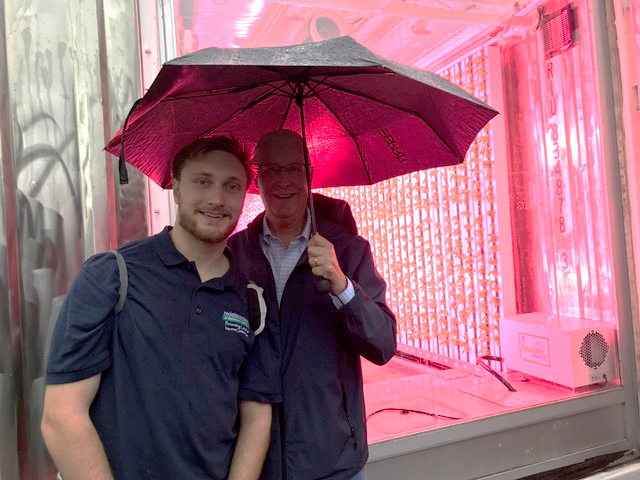
Patrick & his father, Bill, at stand in front of a shipping container growing basil at Square Roots Urban Growers in Brooklyn, NY
I had no clue what I would find at the 2020 Future Harvest Conference. Barbara felt my attendance would be valuable and we’ve been talking about the issue of Urban Farming for some time. I went to the conference with an open mind considering this to be a very broad, open-ended subject. Urban Farming can apply to any number of ideas, from orchards to animal husbandry and we’d yet to decide on our best path forward.
Aside from my trip to Brooklyn to check out Square Roots Urban Farming and a few groups we’ve spoken with locally, I still felt like we had a lot to learn.
On Thursday I attended a Pre-Conference workshop on Hemp. It didn’t take long to realize NeighborSpace wouldn’t be hosting the County’s next great Hemp farm. As I sat there, I contemplated our next big project; Gray to Green, which refers to restoring paved properties back into natural land. I considered the potential of turning industrial lots in the Dundalk-Rosedale area into Urban Forests. By lunch time I remained unsure how this conference would apply to our work at NeighborSpace. At that point it seemed only relevant to rural farmers.
During lunch I found myself talking to a young woman from Virginia. She started discussing her experience growing oyster mushrooms on dead Ailanthus trees at her farm. That caught my interest and I started asking all kinds of questions. Another woman chimed in, raving about the value of mushroom farming. I was intrigued but was unsure how this information would be of value to us.
On Friday morning, I planned to attend the lecture on Beginning Farming, aiming to slip in the back. I was feeling rather skeptical that Beginning Farming would relate to our work, so when I found the room full, I was not overly concerned. I wandered down the hall looking for another way to spend my morning when I stumbled onto Fungi in Agroforestry. This was part of the Regenerative Agriculture Track of courses. I had seen it on the program the day before but until my mushroom conversation at lunch, had not thought to attend.
The Fungi in Agroforestry lecture turned out to be a great. They went into more detail on how to grow oysters mushrooms on Ailanthus trees. The idea is to cut down the tree and (1) Inoculate the log to grow mushrooms & (2) Plant more mushrooms on the stump to suppress regrowth.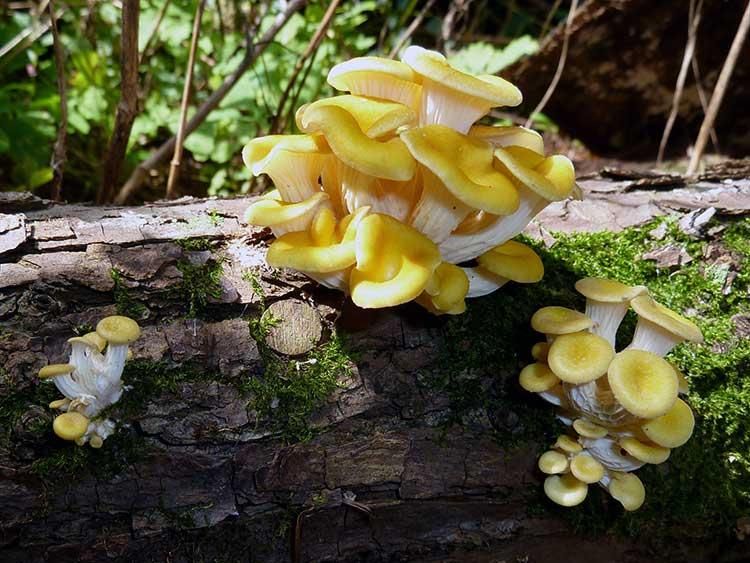 The reason this is important is because Ailanthus (a.k.a. Tree of Heaven), along with Norway Maple and Paulownia (which are also good for oyster mushrooms), are the most common and problematic invasive trees on NeighborSpace sites. This brought me to BIG IDEA #1: Utilize invasive trees on our sites to grow mushrooms which can then be harvested and eaten by the community.
That wasn’t the only thing I learned in that course, however. I also picked up some facts about Mycorrhizal Symbiosis, which refers to the symbiotic relationship between trees and fungi. The gist of this is that fungi (a) provide Nitrogen & Phosphorous to trees in exchange for sugar (b) support the food web by feeding fungivores in the soil (c) enhance soil stability (d) filter heavy metals from the soil. Put simply, fungi in the soil are crucial for the growth of trees.
After class I talked to everyone I could about fungi. I found out the process of enhancing soil quality with fungi was known as “Mycoremediation”, which could be used to promote tree growth. This brought me to BIG IDEA #2: Use mycoremediation to make Gray to Green projects a reality. This means adding fungi to the low-quality soil, likely to be found on such sites, to enhance soil quality and spur successful tree and plant growth.
My learning was not complete, however, one more big idea remained. The idea was prompted by Saturday’s keynote speaker and soil genius, Dr. Elaine Ingham. In brief, Dr. Ingham stated that the basis for healthy soil is good soil biology. Among the fascinating claims she made was that weeds grow when the soil’s fungal-bacterial balance is out of whack. A good balance, leads to good ammonium content which eliminates weeds. YOU DO NOT NEED HERBICIDE. If there is too much fungi (more likely) add molasses to feed bacteria. If there is too much bacteria (less likely) add humic acid to feed fungi. This gave me BIG IDEA #3: To free our sites of English Ivy and Japanese Honeysuckle, ditch herbicides and use natural methods instead.
With any big idea, action steps are required. Step one will be doing our research. Our starting point is to read the book “Organic Mushroom Farming and Mycoremediation” by Tradd Cotter which I purchased at the conference. This will give us tips for BIG IDEA #1: Growing Mushrooms and BIG IDEA #2: Using Fungi for Gray to Green. We already have a number of sites that could be ideal for growing mushrooms including Dunmore in Catonsville and Cherry Heights Woodland Garden in Overlea. We also have a site that will need soil remediation once it gets depaved at Flannery Park. For BIG IDEA #3 I will be visiting Honey’s Harvest Farm in April where Anna Chaney is attempting to use molasses and humic acid to balance her soil and rid her farm of weeds. I am hopeful that the knowledge of fungi picked up at this conference will guide innovative steps in our work for years to come.