
Share this article

Guest article by Adreon Hubbard

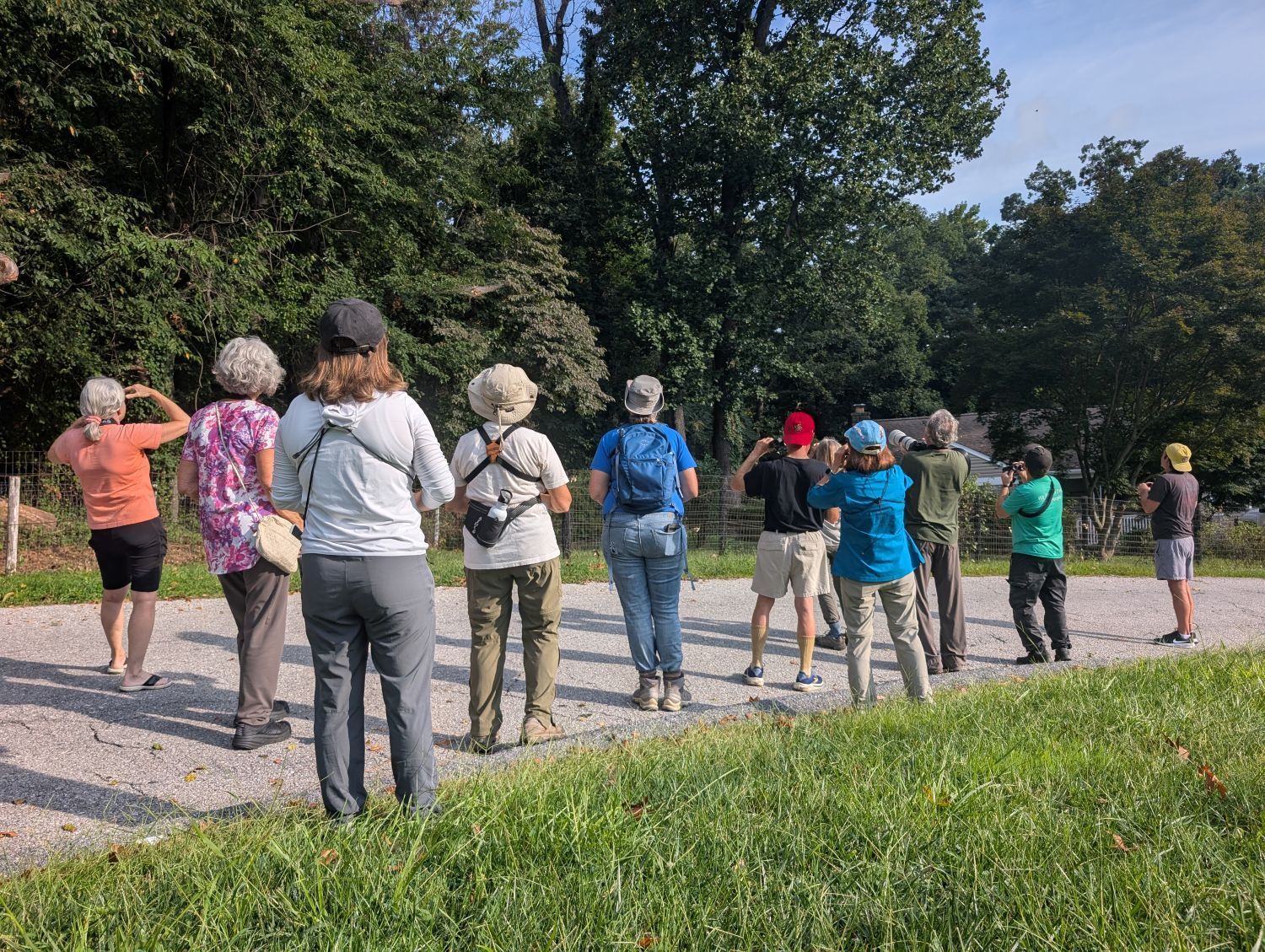
In late February, with the long streak of subfreezing, snowy days finally over, I had the honor of leading a forest nature walk on a beautiful day at Volz Park for members of the Green Towson Alliance (GTA). Volz Park, one of NeighborSpace’s three wooded riparian buffer sites, is a 16-acre forest preserve surrounded by townhome developments in the Bird River Watershed in Middle River. As a volunteer naturalist and TreeKeeper, I was excited to become better acquainted with this little gem and introduce it to my GTA colleagues. Armed with binoculars, a hand lens, the Winter Tree Finder key, and the trusty iNaturalist app, I made observations and came up with a species list and tips for my fellow “nature nerds.”

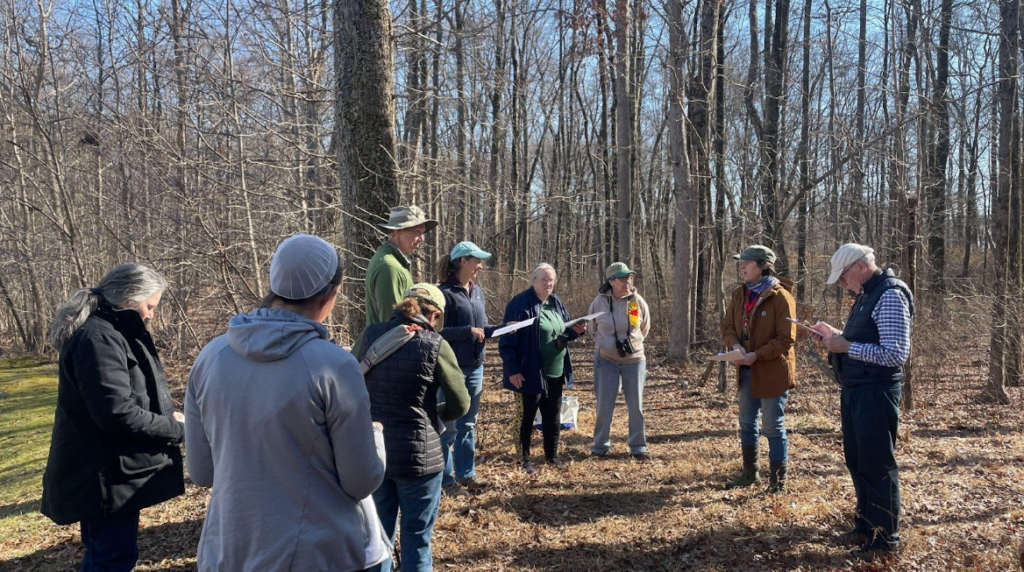
Adreon, 2nd from right, gives an overview of the flora and fauna in Volz Park at the start of the Green Towson Alliance nature walk. (Photo taken by participant Micheli Zurawel)

Winter Woodies: Tree ID Tips

  • Leaf arrangement : Are the leaves or leaf buds opposite (in pairs), or are they alternate (single), along the branches? If they are opposite, it’s probably a maple, ash, or dogwood. Most tree species have alternately arranged leaves. Volz has a number of mature red maples, easily identifiable in winter by their leaf and flower buds appearing in opposite pairs and the red color of the twigs. Hint: look for fallen leaves on the ground nearby–red maple leaves have 3 lobes. 

  • Bark type : What type of bark does the tree have–ridged and furrowed, peeling, shaggy, blocky, or smooth? Note: the bark can vary from the bottom to the top of the tree and according to the tree’s age. Hint: It is very difficult to identify a tree by its bark alone, especially trees with ridged and furrowed bark, a common bark type. Always try to use multiple features of a tree when trying to identify it.

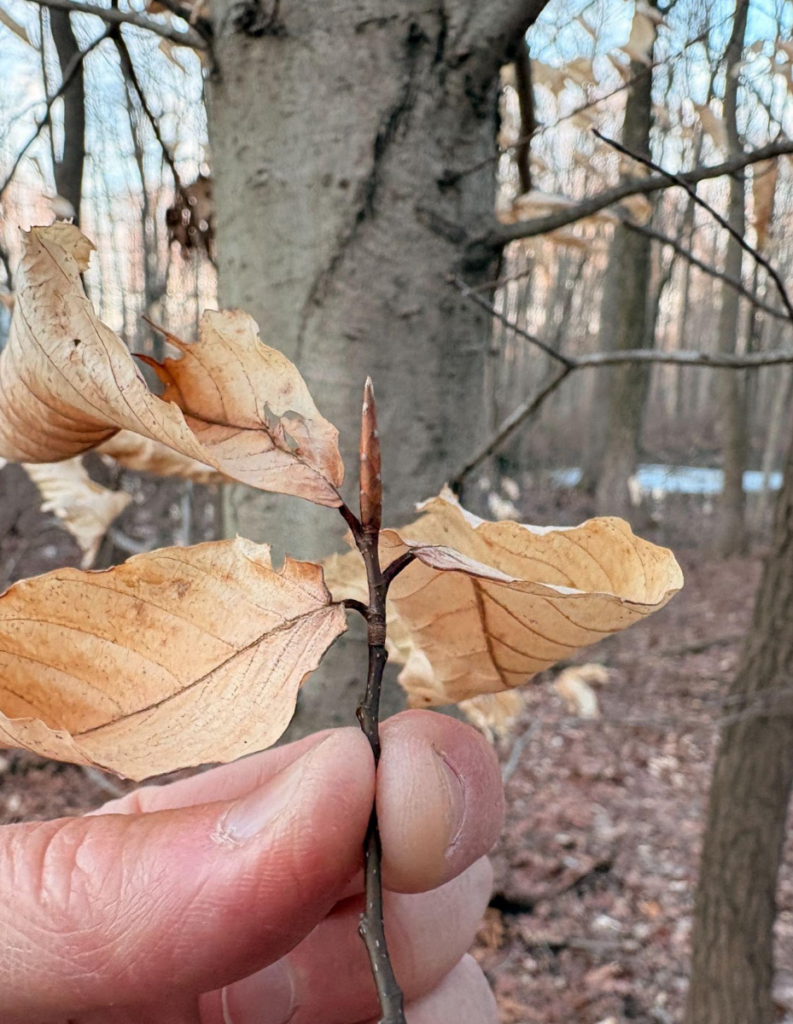
  • Twig anatomy : Examine a tree twig up close. Look at the bud at the end (terminal bud). If the terminal bud is long, skinny, and brown, like a little cigar, the tree may be an American Beech (see photo). If there are multiple terminal buds clustered together, it may be an oak. Hint: if you want to “geek out” on twig anatomy, the Winter Tree Finder key by Watts & Watts is very helpful.

Golden-brown marcescent leaves make the American Beech an easy tree to identify in winter. (Photo by Adreon)

  • Lenticels : Lenticels (LEN-ti-sels) are tree pores in the bark that facilitate gas exchange, and they come in a wide variety of shapes, sizes, and textures. Lenticels on Spicebush are raised white dots, while lenticels on Black Cherry trees are horizontal lines. 

  • Conspicuous Features : If the above tree ID tips seem esoteric, try focusing on more conspicuous clues such as leaves remaining on the tree in winter: this is called marcescence (mar-SES-ence). Beeches and oaks are often marcescent. The golden-tan leaves of beech trees in winter, especially when shimmering and rustling in the breeze, immediately catch one’s eye or ear in the otherwise bare woods. Fallen leaves or fruits/nuts/acorns can be diagnostic as well. You can’t miss the profusion of spiky “gumballs” from Sweetgum trees littering the ground at Volz!  

The group identified about 10 native tree species overall: American Beech, Black Cherry, Blackgum, Pignut Hickory, Red Maple, Red and White Oak species, Sweetgum, Tuliptree, Virginia Pine, as well as plenty of Spicebush. I love the cinnamon-like aroma of this hardy shrub!

Winter Birds at Volz

As someone who prefers not to get up early, I was pleased to have identified about 20 bird species at Volz in the afternoon/evening this winter. Birds I heard or saw: American Crow, American Robin, Brown Creeper, Canada Goose, Carolina Chickadee, Carolina Wren, Common Grackle, Dark-eyed Junco, Downy Woodpecker, Eastern Bluebird, Fish Crow, Mourning Dove, Northern Cardinal, Northern Flicker, Red-shouldered Hawk, Red-winged Blackbird, Tufted Titmouse, Turkey Vulture, White-breasted Nuthatch, and White-throated Sparrow.

Bird ID Tips:

LISTEN. Use the free Merlin Bird ID app, which identifies birds by their sounds. 

LOOK. Look for movement in the sky, canopy, understory, brush, and on the ground. Use binoculars to zoom in once you see something.

NOTICE. Birds can often be identified as much by what they are doing as by their appearance. Knowing this can help you figure out birds even without binoculars. A bird creeping head-first down a tree trunk can only be a White-breasted Nuthatch. A bird flying through the forest with a flap-flap-glide wingbeat pattern may be a woodpecker. 

Brown Creepers  
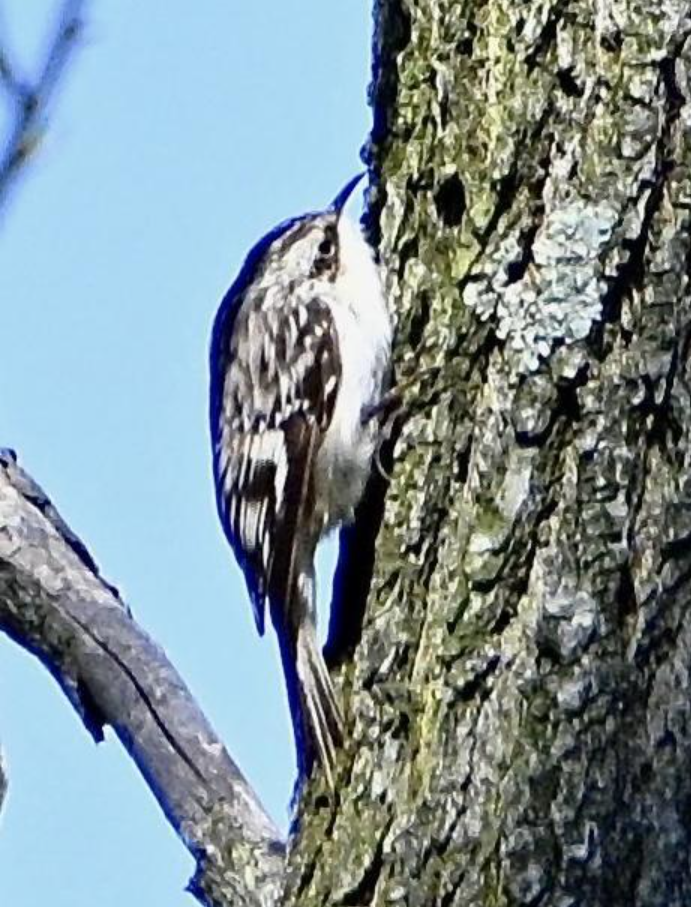
One of the most intriguing birds I’ve seen at Volz is the Brown Creeper. This elusive, tiny bird’s brown, streaked back makes it perfectly camouflaged against tree bark. It is often described as a “piece of bark come to life.” Creeping jerkily up tree trunks in a corkscrew pattern, it uses its long, stiff tail feathers to brace itself against the tree and its down-turned beak to probe bark crevices for tasty arthropods. Rather than creeping face-down like a nuthatch, it flies down, resembling a falling leaf, to the next tree, where it scampers up again. Brown Creepers rely on mature trees whose bark is craggly enough to harbor the tasty spiders and caterpillars they seek, so their presence is said to be a sign of a healthy forest ecosystem. Keeping some dead and dying trees, as well as snags, allows Brown Creepers to make their pouch-like nests behind loose tree bark. See https://www.allaboutbirds.org/guide/Brown_Creeper/overview. Maybe you will spot a Brown Creeper or hear its high-pitched vocalizations on your next visit to Volz!

The Brown Creeper “creeps” up tree trunks looking for bugs in bark crevices. (Photo taken at North Point Park by GTA member Beth Miller)

Fungi and Fireflies

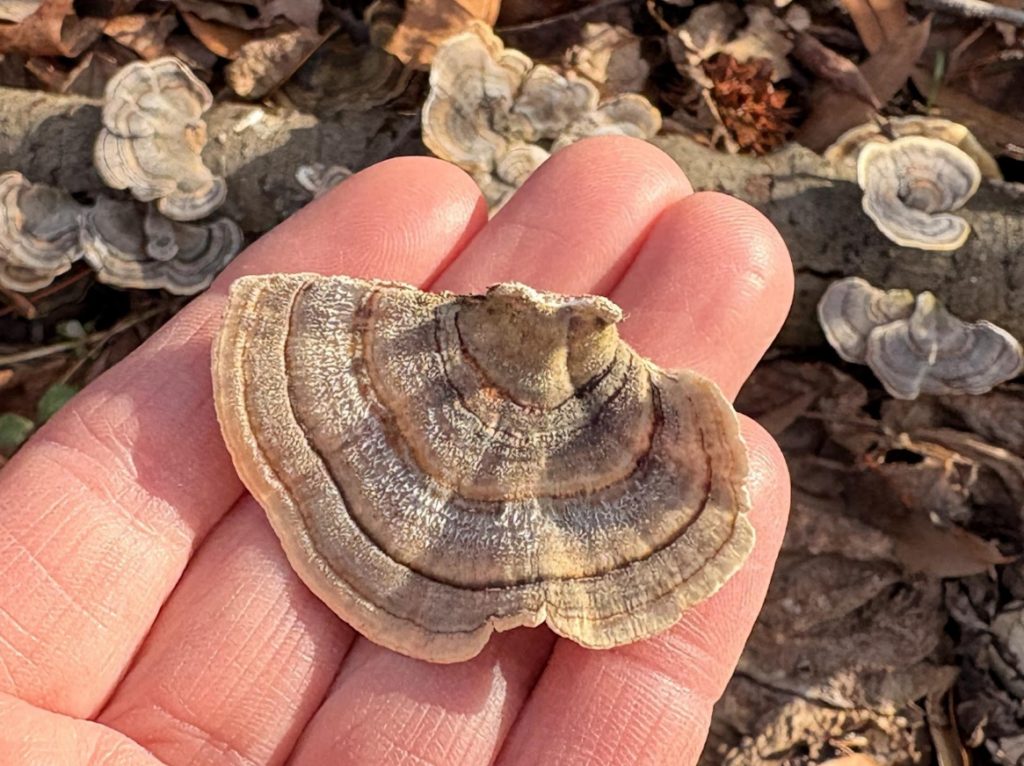
Turkey Tail mushrooms are common on dead wood and sport concentric bands of tan, grey, blue, and reddish-brown, resembling their namesake. Turkey Tail can be seen throughout the park. Pull one off the tree or log and feel its velvety top and rough underside, which is covered in tiny pores that resemble coral. False Turkey Tail is a lookalike that has a smooth underside.

Turkey Tail is a beautiful shelf mushroom decomposer that grows on dead wood. (Photo by Adreon)

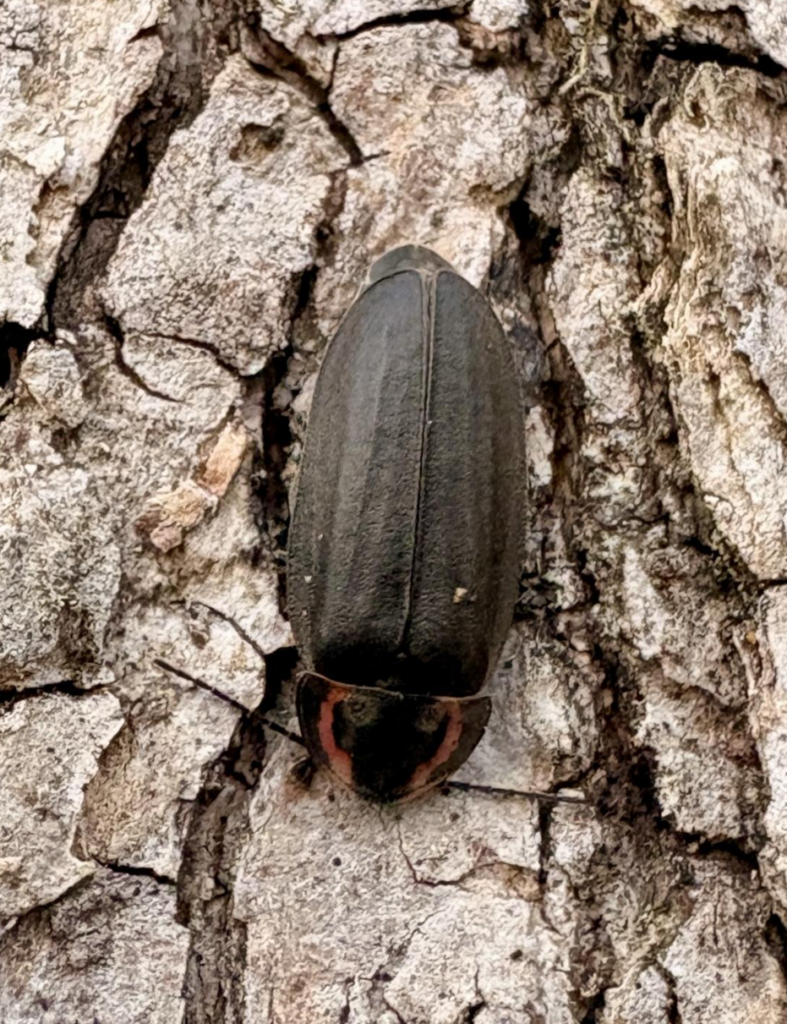
Winter Firefly : Winter Fireflies overwinter in tree cracks and are often the first insect to emerge in late Winter or early Spring. The adults are diurnal, or active in the day, so they do not bioluminesce as adults. They sometimes fall into maple syrup buckets, hence their other common name, Sap-Bucket Beetle. This little guy at Volz (see photo) was my first encounter with one. It is always exciting to discover a new species!

Winter Firefly. I never knew this species existed until seeing one at Volz Park! (Photo by Adreon)

I am grateful to NeighborSpace for preserving the forest at Volz and inviting me to lead a walk there. I can’t wait to visit in all four seasons!

Adreon is a retired teacher and Certified Maryland Master Naturalist volunteer. She can be reached at hubbardesol@gmail.com .

Recent Posts

By Will Kaselow August 10, 2026
Live Music and Ribbon Cutting at Graystone 7/28/26 | Will Kaselow, Community Conservation Manager
By Will Kaselow July 29, 2026
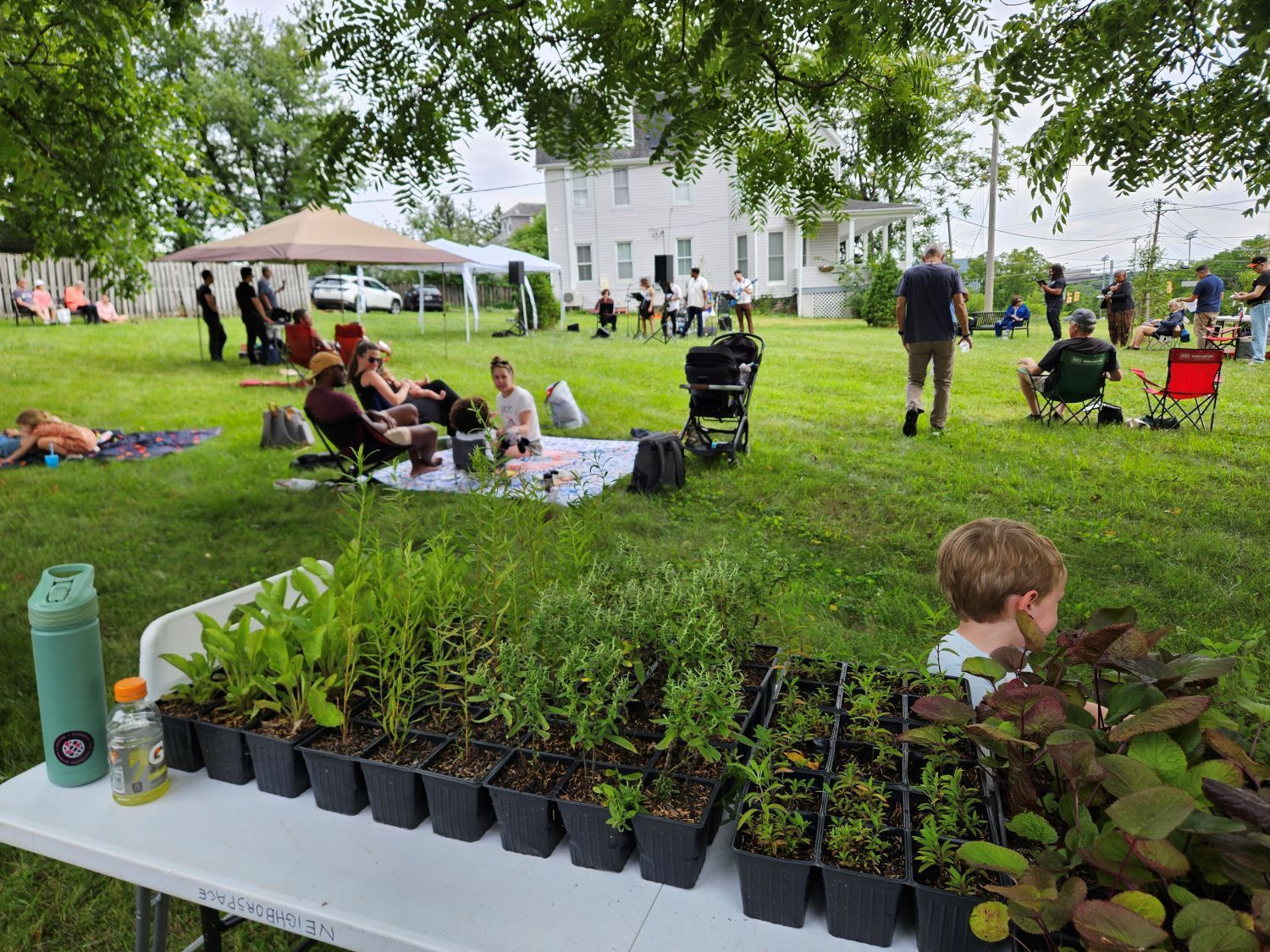
7/28/26 | Will Kaselow, Community Conservation Manager Thank you to everyone who came out to NeighborSpace’s final concert of the summer! After the original date was cancelled due to wildfire-related air pollution, we were able to quickly reschedule and ended up lucking into one of the most beautiful nights of the summer so far. We […]
By Phyllis Joris July 29, 2026
7/29/2026 | Phyllis Joris, Executive Director Like many nonprofits, NeighborSpace operates on a fiscal year that runs July through June. This month, NeighborSpace staff and board members took stock of progress made in the past year and drafted a work plan for the coming year. More details will be provided in NeighborSpace’s Annual Report, which […]
By Carol Partonen July 29, 2026
Thanks to donations from generous supporters like you, NeighborSpace was able to hire three interns this summer. We want to help young conservationists gain fieldwork and behind-the-scenes experience, and staff is grateful for the extra hands and minds! We introduced you to our stewardship interns last month.Now read on to meet our communications intern, Mykiah. […]
By Carol Partonen July 28, 2026
Barbara Waters While I grew up in Massachusetts and then spent 6 years in Northern Maine, I have now lived in Maryland for nearly 32 years. I had been involved in many things in the community, but that involvement really ramped up once the pandemic started. To combat isolation, I started walking daily, and have […]
By Carol Partonen June 29, 2026
Thanks to donations from generous supporters like you, NeighborSpace was able to hire three interns this summer. We want to help young conservationists gain fieldwork and behind-the-scenes experience, and staff is grateful for the extra hands and minds! Read on to meet our two stewardship interns, Ashley and Katie. Hi! I am Ashley Metzbower. I […]
By Will Kaselow June 29, 2026
6/29/26 | Will Kaselow, Community Conservation Manager This month we welcomed the summer with song, hosting live music events at two of our sites! First, Patrick Alban and his Buena Vista Social Club joined us at Ridgely Manor Park in Towson on one of the hottest nights of the year so far. Despite the heat, […]
By Conor Harrington June 29, 2026
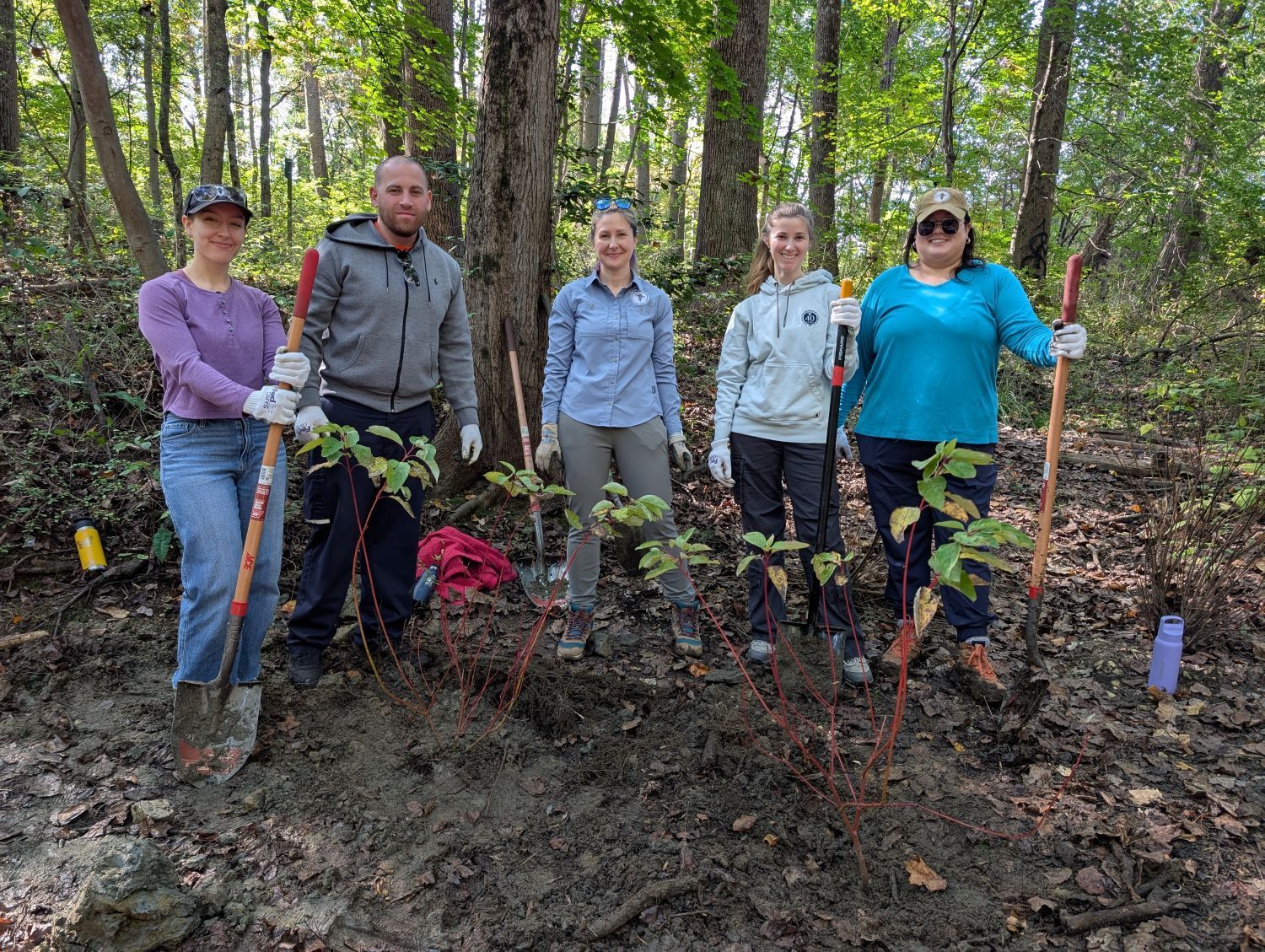
6/29/26 | Conor Harrington, Land Steward This spring, NeighborSpace installed its first microforest/Miyawaki plantings at Tollgate Wyndham Preserve in Owings Mills. With the help of some very dedicated volunteer groups from BGE and Stanley Black & Decker, we planted about 150 trees and shrubs in three contained locations of the preserve. The area covered by […]
By Phyllis Joris June 29, 2026
6/29/2026 | Phyllis Joris, Executive Director NeighborSpace recently added a new site to its portfolio! With the addition of Stonegate, a beautiful 16-acre property in Catonsville, NeighborSpace now protects 116 acres across 22 sites for current and future residents of urban Baltimore County. This property is co-held with Maryland Environmental Trust (MET), the state’s land […]
By Will Kaselow May 29, 2026
This month we would like to thank Christie Bianco for her time and dedication as a NeighborSpace volunteer! Christie has lived in the Dunmore community for 21 years and first connected with Levickas Woods through her children, who would play in the woods and catch crayfish in the stream. She considers the woods to be […]
Show More