In his 2020 book, Nature’s Best Hope , ecologist Doug Tallamy argues that habitat has become so fragmented that a healthy ecosystem, one that can sustain the living systems on which all life depends, is no longer possible through conservation alone, a hard truth for a land trust like NeighborSpace. In Tallamy’s view, there simply isn’t enough vacant land left to do the job.
What must be done to avert a crisis, according to Tallamy, is to create habitat on private lands, e.g., individual yards and corporate and institutional campuses. Tallamy suggests that “[i]f we connect tiny isolated natural areas by building biological corridors between them, the species that live there can intermingle and increase their populations.” [1] He argues, further, that “restoring viable habitat within the human-dominated landscapes that separate habitat fragments – with as much of the land as possible – is the single most effective thing we can do to restore the ecological integrity of these landscapes.” [2]
Where are there an abundance of “yards” and common areas of turf in most urbanized areas? The answer lies in homeowner association (HOA) communities. Across the U.S., almost 70 million people (about 20% of the total population) reside in an HOA community. Virtually all new housing developments in the U.S. are associated with an HOA. According to our GIS analysis, there are 4,300 acres of HOA lands in Baltimore County, most of it inside the Urban Rural Demarcation Line (URDL), as shown in the map below. There are at least 2,922 parcels greater than 900 square feet in size.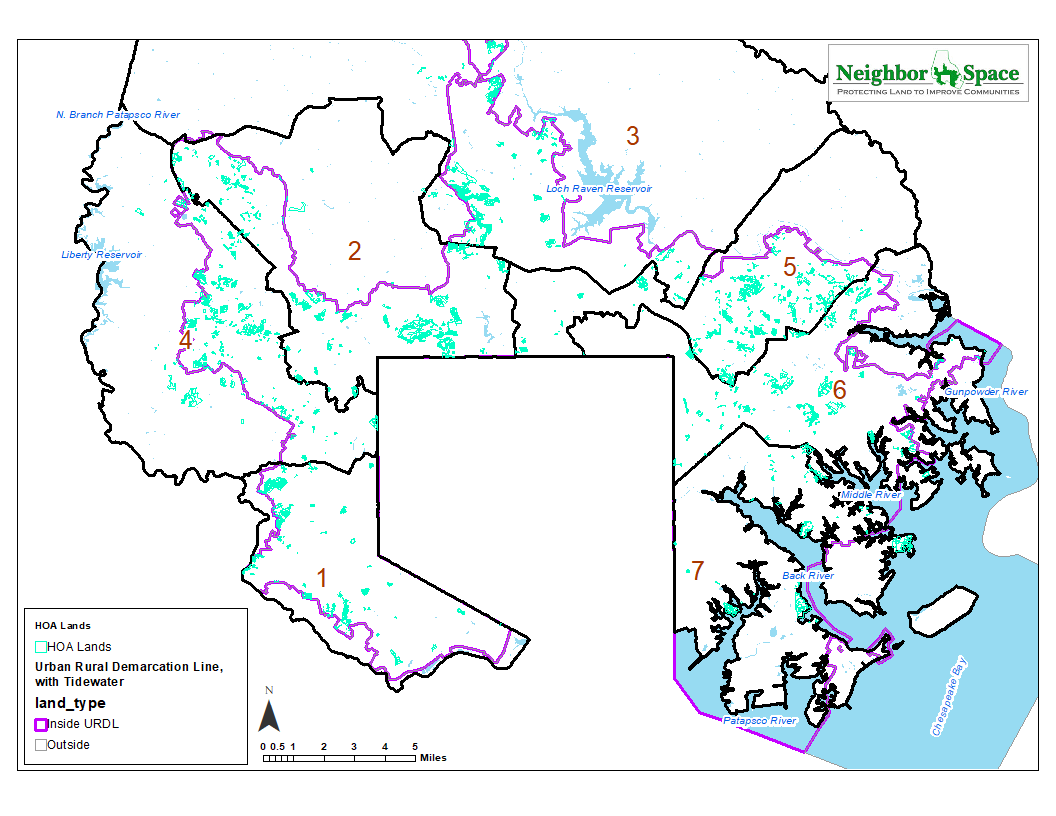
Many of these areas, particularly those developed in the 20 th century, are not managed by sustainable or environmental best practice standards. They are frequently of limited use both for human activity and for environmental protection, such as providing habitat for pollinators and managing stormwater runoff sustainably. In addition, their maintenance can be costly, with landscaping expenses approaching 75% of an annual HOA budget, according to one source. It is our assumption that a win-win could be created through a new project, Habitat Baltimore County (HABACO) Preserve if environmental best practices on HOA lands would save on maintenance costs and create a more sustainable environment for both people and pollinators. It is our further assumption that demonstrated maintenance cost savings would drive more HOAs to want to participate, helping to create the “biological corridors” for which Tallamy advocates.
This idea is not an entirely novel one. In 1996, landscape planner, Randall Arendt, published Conservation Design for Subdivisions, arguing for development projects to leave half or more of a project site as open space that could serve as a building block within a community-wide system of open space. [3] Many municipalities embraced the idea by amending their subdivision ordinances to promote Arendt’s design tenets.
More recently, there are precedents for retrofitting conservation design ideas into traditionally-planned HOA landscapes, as HABACO proposes:
- The Cherry Creek 3 HOA in Denver, CO has transformed traditional landscaping into water-wise xeriscape areas, decreasing water consumption from a peak of 36.7 million gallons to 20.8 million gallons. [4] The plantings have also increased biodiversity.
- The Sharon Park HOA in Menlo Park, CA created public pollinator gardens that have been certified by the National Wildlife Federation. [5]
- In terms of standards, there is one paper suggesting that adopting strategies from the Sustainable Sites Initiative is a way to better manage HOA lands. [6] The Sustainable SITES Initiative is a set of comprehensive, voluntary guidelines together with a rating system that assesses the sustainable design, construction, and maintenance of landscapes.
With these precedents and the theory behind HABACO Preserve as guides, NeighborSpace proposed, and the Chesapeake Bay Trust (CBT) awarded, $74,195 for the organization to work with a design partner to develop a conservation landscape and stormwater management plan for retrofitting green infrastructure and pollinator habitat into 43 acres of HOA open space at the Village of Twelve Trees community in Randallstown, shown in the map, below.
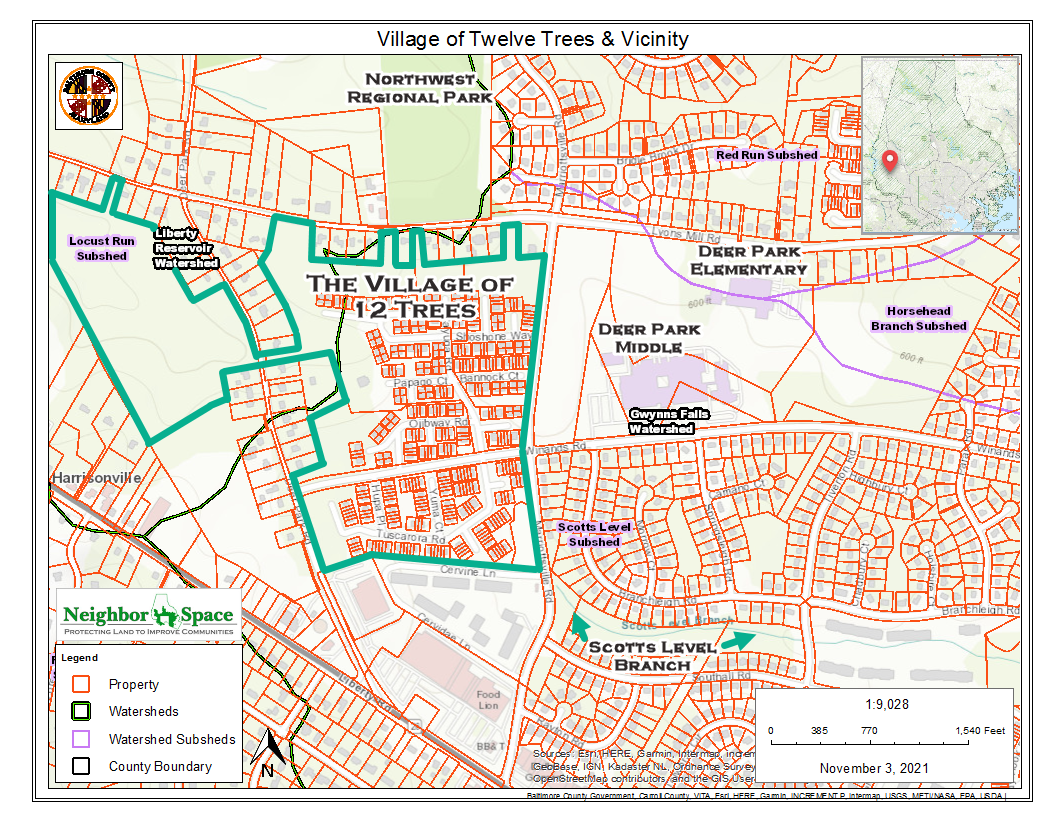
Specifically, the effort will involve a design partner assisting NeighborSpace and the Village of 12 Trees with a community-driven conservation landscape plan for habitat and stormwater management. This unique plan will be co-designed and implemented by community volunteers working with landscape designer and arborist partners. The design partner will engage the community in a co-design process to create an overall conservation-based plan that sustainably addresses stormwater with things like rain gardens, bioretention, vegetate swales, and new native plantings. Community residents will select habitat restoration areas from a menu of projects, each designed at a scale that can be planted by volunteers with contractor assistance when needed.
Through this program, the design partner will develop planting designs and management recommendations for each project type. After the engagement and design phase is complete, NeighborSpace will work with the Village of 12 Trees HOA to seek additional funding for the implementation phase and help to train volunteers on ongoing maintenance. NeighborSpace will also work with the HOA's landscape contractors to evaluate and revise current maintenance plans and practices.
NeighborSpace hopes that the project will result in a more aesthetically pleasing and sustainable landscape for the residents of the Village of 12 Trees, as well as a landscape that can be maintained at a much lower cost. Our pollinator friends, and the future of our food supply, are counting on us to get this right, given that we cannot conserve our way out of the challenge articulated in Nature's Best Hope.
_______________________________________
Notes
[1] D. Tallamy. Nature’s Best hope: A New Approach to Conservation That Starts in Your Yard. (Timber Press: Portland, Oregon)(2019).
[2] Ibid.
[3] R. Arendt. Conservation Design for Subdivisions: A Practical Guide for Creating Open Space Networks (Island Press: Washington, DC) (1996).
[4] S.B. Lerman, et. al. “Homeowner Associations as a Vehicle for Promoting Native Urban Biodiversity.” Ecology and Society , 17(4):45 (2012) (Available at: http://www.ecologyandsociety.org/vol17/iss4/art45/).
[5] Ibid.
[6] Ibid.