Teaching Us What “Home” Is and Why We Should Care: A Tribute to Adelaide Bentley
 In their book,
The Abundant Community: Awakening the Power of Families and Neighborhoods
, authors, John McKnight and Peter Block, note that healthy or “competent” communities have three characteristics:
In their book,
The Abundant Community: Awakening the Power of Families and Neighborhoods
, authors, John McKnight and Peter Block, note that healthy or “competent” communities have three characteristics:
- First, they focus on the gifts of their members, their unique skills and abilities;
- Second, they foster and value cooperation; and
- Third, they offer hospitality and nurture.
(J. McKnight& P. Block. The Abundant Community (2012), pp. 66-67).
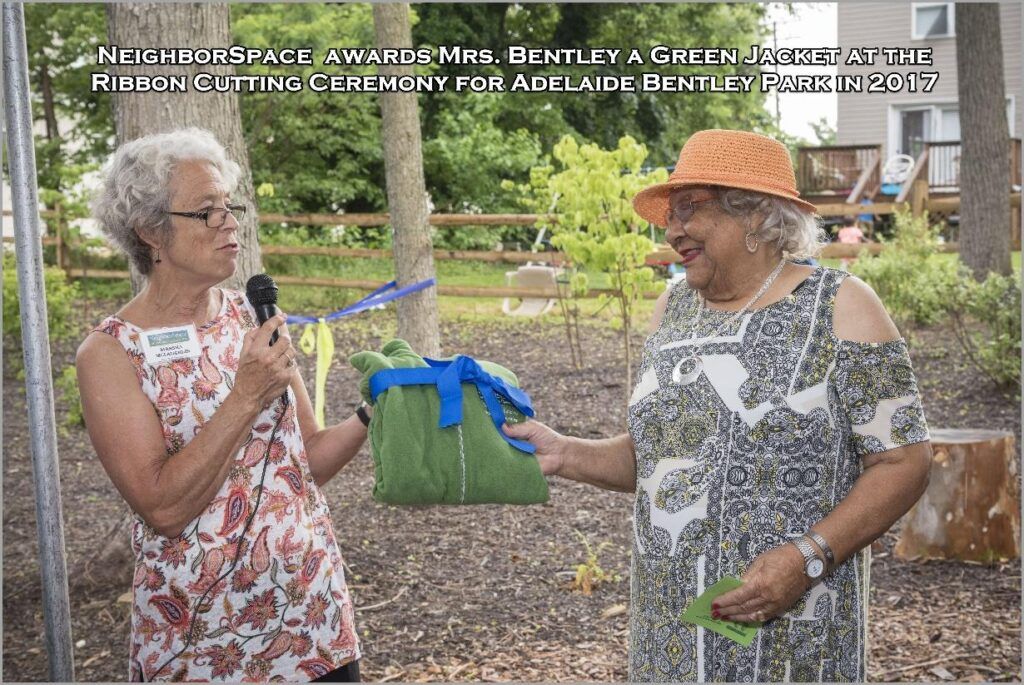
Competent communities can often be great stewardship partners, which is what drew me to the book initially. But these communities don’t magically appear out of thin air. Rather, according to McKnight and Block, they are built over time by those who have the capacity to connect others. We lost one of these community connectors and leaders, Adelaide Bentley, on April 2. Our park in historic East Towson, shown below, was named in her honor in 2013. So, today, I want to take a moment to reflect on her life and on
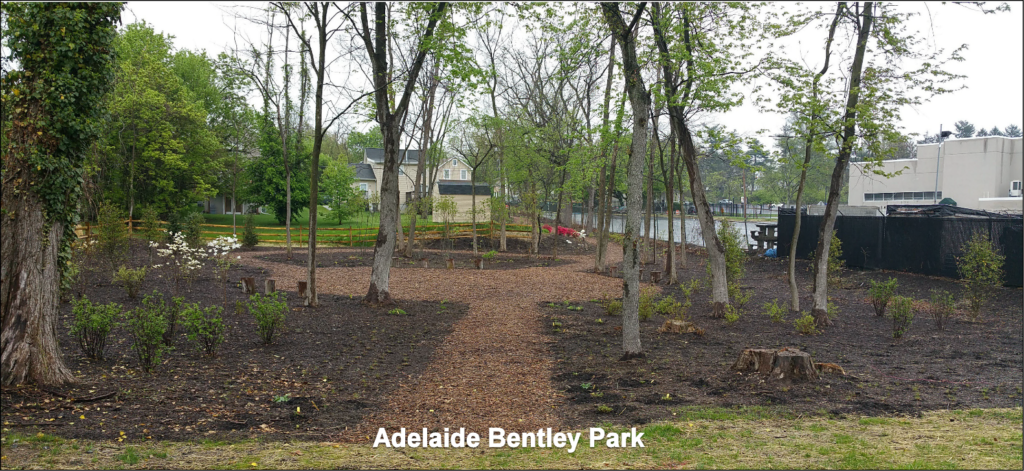 the historic East Towson community that was, and, arguably, still is, a healthy and competent community because of her life-long dedication to it.
1 . The Historical Context
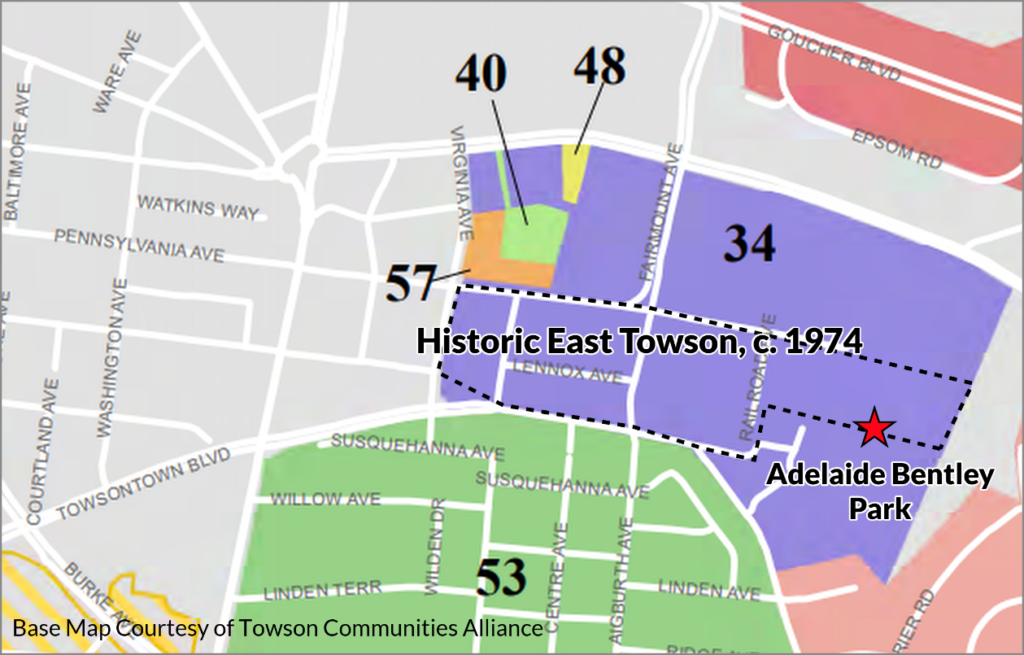
Mrs. Bentley was born in East Towson in 1928. The historically black neighborhood was founded by freed slaves in the 1850s, years before the end of the Civil War. Citing the work of well-known, local historian Louis Diggs, a 2019 Towson Times article explains the event by noting that Charles Ridgely, a former Maryland governor and owner of the Hampton Mansion, died in 1829 and freed a portion of his slaves upon his death. (L. Solomon. Towson Times , Feb. 12, 2019). Some of these men and women settled in Towson, in the very area that is Historic East Towson, as shown in the map above.
The Towson Times article goes on to note that the first African-American to buy land in East Towson was freed slave, Daniel Harris, who paid $187.50 for 1.25 acres of land near what is now Hillen Road in 1853. More black families, including Mrs. Bentley’s, followed and lived in East Towson for generations. (L. Solomon). The same article notes that her grandfather settled there and was a co-founder of the Mount Olive Baptist Church at the intersection of York Road and Bosley Avenue.
2. Competent Communities: Cooperation and Connectedness in Historic East Towson
Alluding to the connectedness and cooperative nature of people living in “competent communities,” Mrs. Bentley is quoted in the 2019 Towson Times article as saying: “Everybody was connected … everybody knew each other. Your parents could correct me, my parents could correct you. It was that kind of relationship. Everybody looked out for each other … We were one big knit.”
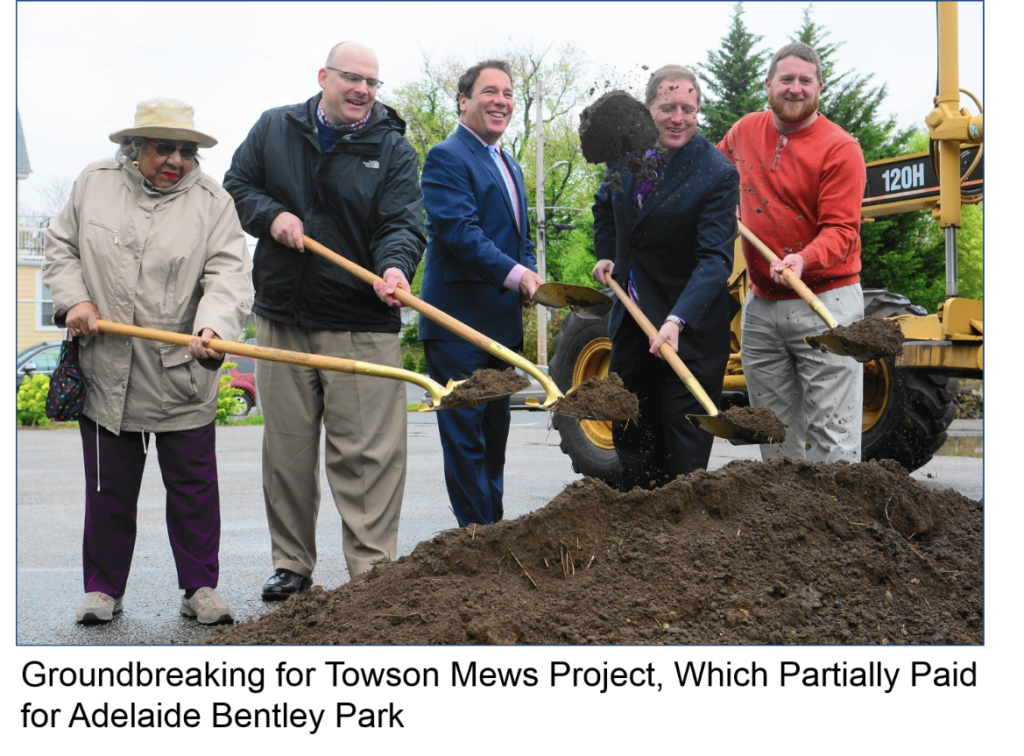
But development pressures reduced the community’s boundaries over time, razing homes to make way for the District Courthouse and Towsontown Boulevard, to name a few of the projects. (L. Solomon). In fact, NeighborSpace received partial funding for construction of the park that bears Mrs. Bentley’s name as a community benefit from the developer of a luxury townhome project, Towson Mews, on the western end of East Pennsylvania Avenue, a site that was once part of Historic East Towson. Before the townhome project broke ground, an office building occupied the site.
Speaking to these development pressures, the 2019 Towson Times article notes that:
[f]ew historic structures remain at the western end of the community as a result of the expanding commercial and governmental activities of Towson … Large-scale housing with commercial space on the first floor and office buildings have been constructed on the now-joined building lots that were created as part of East Towson, thereby blurring the edges of the neighborhood with that of Towson-proper. Furthermore, many of the historic structures in this section of East Towson have been lost in favor of parking lots. (L. Solomon)
Mrs. Bentley alluded to the toll that development pressures had taken on the neighborhood, noting that: “It’s really not my neighborhood anymore. … It’s changed …. At one point in my life it was nothing but black folks. But now it’s different.” (L. Solomon). That same article stated that “at the start of the 1960s, East Towson had as many as 160 single-family, owner-occupied homes. Today, the number is closer to 70.” (L. Solomon).
3. Competent Communities: Members with Valuable Organizing and Advocacy Skills
Several factors kept the community from being completely annihilated in the 1960’s and 1970’s. Among these are the fact that most residents owned their homes, that Baltimore County has a long history of underperformance in providing affordable housing such that there were few relocation options for displaced residents, and advocacy from community leaders like Adelaide Bentley. Commenting on these abilities, Towson Communities Alliance member, Mike Ertel, noted in Mrs. Bentley’s obituary that “she was a force to be reckoned with. She was like a general in the field ... I liked the fact that county government was a little afraid of her. “(F. Rasmussen, Baltimore Sun , April 5, 2020).
Strong community figures were definitely the order of the day, when, in 1964, then-County Executive Spiro Agnew vowed to engage in a slum-clearance program that would rid East Towson of what were seen as sub-standard homes and sell the land to private developers. The construction of Towson Towne Boulevard and County Executive Dale Anderson posed the next threat, but the dearth of affordable housing options, and the County government’s intransigence on that score, made relocating residents a difficult proposition. The slum clearance program never happened and Towson Towne Boulevard’s reach through the community was reduced, as a result.
4. Competent Communities: Nurturing a Sense of Home
Speaking to the hospitality and nurturing values of a competent community, Mrs. Bentley offered these comments in the 2019 Towson Times article:
I had a beautiful life here. And I’m still enjoying my life here,” Bentley said. “It’s just the openness, and the few people that’s left, and friends, and family, you know.” It may have changed, Bentley said, but East Towson is still home …. “Most people don’t know what home is,” Bentley said. “They don’t know what home is.” (L. Solomon)
In his book, People Habitat: 25 Ways to Think about Greener, Healthier Cities , author F. Kaid Benfield notes that:
When we think of “sustainability,” we are usually considering the viability of a place or actions into the future …. But, I increasingly think that, when we consider that nourishing the human spirit is just as important to people habitat as conserving natural resources – we also must consider the past: we must understand what, exactly, we seek to sustain. (K. Benfield. People Habitat: 25 Ways to Think about Greener, Healthier Cities (2014), p. 70).
The takeaway is a profound one: it’s not enough to protect land or even to improve it with parks and gardens. If we truly want to sustain communities, we also need to try to understand and preserve that which nurtures the human spirit, that which makes those who live there feel like “they’re home.” Only then will we have fulfilled our duty of furthering sustainability and its cousin livability, which lies at the heart of the NeighborSpace mission.