Making Baltimore County an Age-Friendly Community: Much Work to Do
The fact that Baltimore County’s population has been steadily increasing for years is not breaking news. The fact that the County’s senior population has been increasing at a much quicker pace might be. Baltimore County already ranks first in the percentage of seniors in its population among Maryland’s ten largest counties and estimates are that this distinction is unlikely to abate.
In 2020, the County’s population is projected to rise to 847,000 people, a 2.4 percent increase over its 2015 population of roughly 827,000 and a result that belies a stark reality when it comes to the proportion of the population who are seniors. Between 2015 and 2020, the county’s 60+ population is expected to rise from 185,000 to 206,000, an increase of over 11 percent, with the result that senior citizens will make up one quarter of the County’s population. This trend begs many policy-related questions around how we will accommodate and serve an aging population in Baltimore County and it is the reason for a new County initiative, Age-Friendly Baltimore County, a program of the American Association of Retired Persons (AARP) and the World Health Organization (WHO).
A press release from the County Executive and the County Department of Aging shows the broader, global context into which the initiative falls:
The AARP Network of Age-Friendly States and Communities is the United States affiliate of the World Health Organization’s (WHO) Age-Friendly Cities and Communities Program , an international effort launched in 2006 to help cities prepare for rapid population aging and the parallel trend of urbanization. The program has participating communities in more than 20 nations, as well as 10 affiliates representing more than 1,000 communities.
Its overarching goal is to build “age-friendly communities” where residents of all ages can enjoy a high quality of life.
Age-Friendly Communities commit to improving livability through a 4-step process: (1) Evaluate the needs of the people (2) Develop an action plan (3) Implement new projects and programs & (4) Maintain an ongoing assessment of the process. The initiative will depend for its success on involving a wide array of residents and stakeholders as partners. They will come from eight different focus areas (1) Outdoor spaces and buildings (2) Transportation (3) Housing (4) Social participation (5) Respect and social inclusion (6) Civic participation and employment (7) Communication and information (8) Community support and health services. By now, you may have surmised that NeighborSpace is writing about this because it has been asked to help with providing accessible public spaces for seniors.
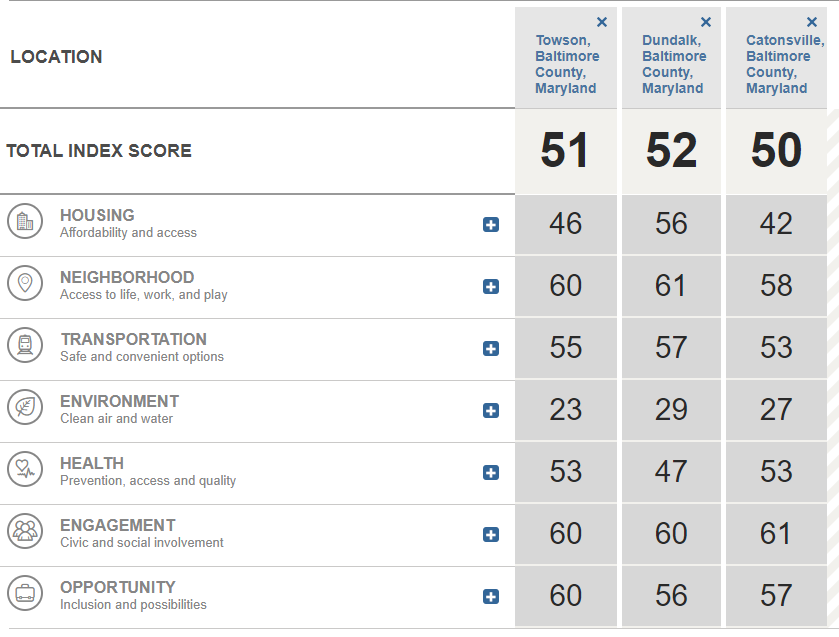
Using a tool on AARP’s website , you can find out how your community stacks up on AARP’s livability scale. Our cursory exploration of it shows that Baltimore County has some work to do, with Towson, Dundalk and Catonsville barely scoring as “average” on a scale where 0 is poor and 100 is excellent:
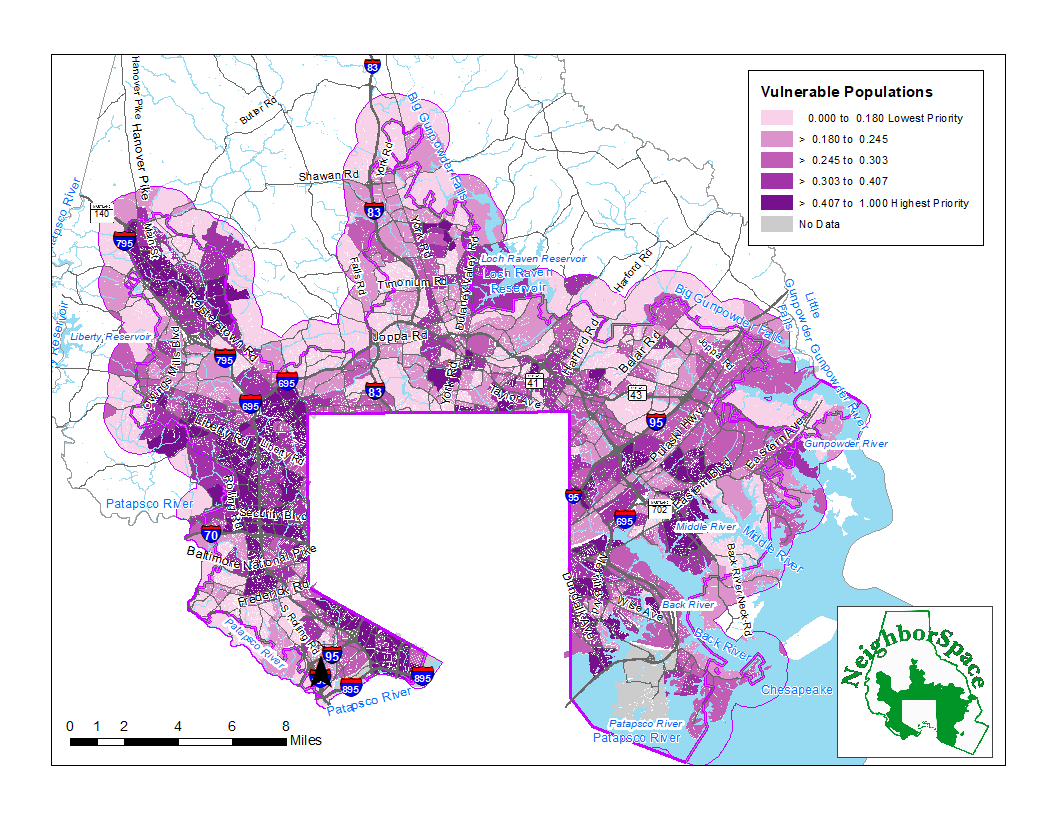
On August 21 st , partners from 50 different organizations, including NeighborSpace, joined County Executive Olszewski, Laura Riley (Director of the Baltimore County Department of Aging) and Attorney General Brian Frosh at Towson University to officially launch the initiative. A Steering Committee has been formed and Executive Director, Barbara Hopkins, has been invited to serve on it. NeighborSpace will utilize its GIS mapping capacity to help identify areas where open space needs for seniors are most pressing and work with partners to identify, conserve and improve land for parks, gardens and trails in those areas.
The map below shows concentrations of vulnerable populations in the County, a GIS layer that includes seniors. We can isolate seniors in this layer and zoom in on areas to identify vacant open space, community associations, churches and other groups that might serve as potential stewardship partners. Stay tuned for updates as this important and timely project moves forward.